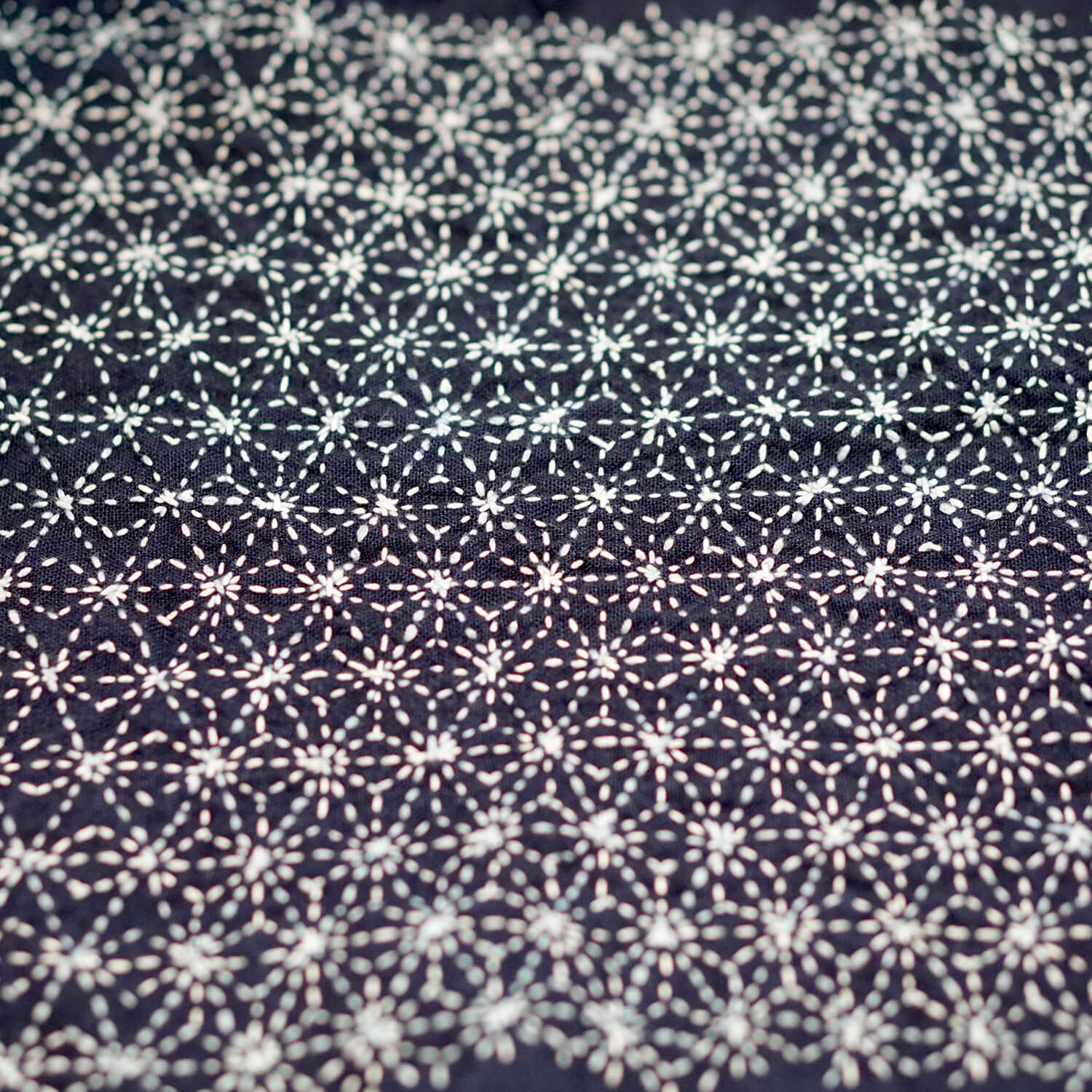
It is my sincere wish to share as many stories as possible in sharing the Sashiko we practice. The Youtube Playlist of “Sashiko Stories” is one of my challenges. Also, a daily update on Instagram with Sashiko Story is another challenge to share the stories. In addition to these platform, I am adding another challenge to share more stories: Sashiko Talk – where I can share the unedited voice of our Sashiko.
The true value of Sashiko Talk
In today’s society where anyone can say anything on any topics with modifying the surface, I realize it is very valuable to share the “unedited version” of its practice – here, Sashiko. “Sashiko Live Streaming” is the answer to this relization. I have been receving many compliment to the Live Streaming where viewers can enjoy our Sashiko stories while watching how I would do Sashiko stitching. At the same time, in the new normal of Covid-19, scheduling the Live-Streaming became very challenging. When the Live Streaming is not scheduled, it became quite difficult for me to talk on a specific subject because English is not my first language.
Sashiko Talk is similar to the Sashiko Live Streaming. The difference is that I invite my Sashiko friends to talk about Sashiko instead of me talking by myself. With having conversation partners, I can elaborate my stories even better. It is my intention for you to listen to the Youtube video as if you are the part of the group. Please bring your own Sashiko project, and stitch together while enjoying the Sashiko Talk.
I often talk by myself. On SNS, in Live Streaming, my voice tend to be understood as my opinion. Listening to the voices around my voice is the true value of Sashiko talk – to balance what I keep saying.
I would like to invite “anyone” interested in Sashiko eventually. As of now, I priotize the people I already know (such as in Patreon / Sashiko Online Class). If you have a strong desire to be on Sashiko Talk, please contact me with introducing who you are. I am happy to consider, but I would like to know you first.
Archives of Sashiko Talk in 2021
I am still improving the way of filiming us & broadcasting the video. By listening to those talks, I believe you will understand what Sashiko is for us much better than just reading books. Please let me know if you have any requests to bring up as a topic.
Sashiko became very popular in a variety of interpretation. I am happy that many people are interested in Sashiko. However, Sashiko is more than just hand-stitching. We have Sashiko Story to share what Sashiko is for us, for the Japanese. Please follow the Instagram/Facebook Account to read our Sashiko Story. Your understanding of Sashiko is probably not wrong, but probably insufficient. I share Sashiko Stories to fulfill the missing essence.
I make myself to share a Sashiko Story a day with introducing the photos of our Sashiko. All of the Sashiko on the photos are done by us: either myself, my mother Keiko, and/or our Sashiko friends who help our Sashi.Co project (or altogether).
Sharing Sashiko Story is a contribution I can do to the Sashiko Tradition. It is all free. Please follow the account & enjoy how Sashiko can be more than just stitching.
This is a comparison photo of back & front of one “Boro To be Jacket” we are working on. There are stories behind why we make one side “back” and one side “Front”. Sashiko Stories are the significance of the Japanese culture.
Sashiko is our life. Sharing Sashiko Story includes sharing very personal stories. Unfortunately, it is too risky to share “everything” where anyone can reach to. I have had very painful experiences caused by cruel trolls. Without many encouragement from followers & supporters on Patreon, I would have stopped sharing it. It can be too painful.
As a return to the support, I share very honest & personal stories on Patreon platform. I am willing to take a risk to share “everything” where they are willing to spend some money on what I write.
There are more than 100 articles in Patreon, and they are all exclusive. Your support to what Atsushi shares is very much appreciated.
One of the frequent questions I receive is about “Knots” at the beginning & ending of Sashiko stitching. “Does Sashiko make knots or No knots?” can be a confusing questions because a learner can find many kinds of answers. It is very understandle to wonder it because one book say “Make knots”, and the other article says “Do not make knots”.
Sashiko make Knots Or Not?
I answer the question on Live Streaming since a listener asked a question.
The Question/request was:
A request for discussion on “Knots”and “No-Knots” in Sashiko.
Is there variety in traditions among stitches?
Is the book oversimplified?
For the answer, please watch the Youtube video & read the summary below. This article is for those who would need a script to understand the video contents.
Script in Youtube after the unedit version of my answer (Please start from:)
After my personal answer to this question, I then moved to a discussion with Sharron if we can find a similar example in the US ordinary. Although it is not the exact same discussion, we came up with an interesting topic – the topping of “pineapple” on pizza. If you are interested, please check the whole Live Streaming on Feb.14th 2021 (https://youtu.be/mwqrEtbbnGA ).
To summarize the question if a Sashiko stitcher should make a knot or should avoid making a knot in Sashiko stitching, I would summarize as follows.
There is no “should” in the decision of making a knot or not. It is based on the preference & project condition. However, I want a Sashiko stitcher to be able to choose. There is a big difference between “Can’t” and “Don’t”. One shouldn’t say that “It is normal to make knots in Sashiko” without the ability to avoid making knots.
Sashiko existed in numbers of places and communities in Japan. Therefore, there is much variety in traditions among stitches. However, within my understanding, all of the Sashiko Stitchers I had to talk to chose Kasane or making knots. They all can “choose”. That’s what I want you to aim for.
It is almost impossible to write the whole picture of Sashiko in one book. It is similar to writing a book about “All cooking” in one book. We would need to focus on each cooking style like “How to make some Japanese ◯◯”. For that, some books I know are oversimplified without proper explanation.
There are many reasons why the Japanese use Kasane to avoid knots. It is very important to learn why & how to avoid the Cultural Appropriation. It makes so much sense when we learn the stories. The Sashiko was a stitching practice in poverty. They didn’t have luxury to cover the backside of Fabric. They wanted to make the backside as beautiful as the front. Then, the knots became a problem.
Meanwhile, when the purpose is for purely mending, knots could be must, therefore we can find knots in some Boro pieces.
Please try to see the whole picture of Sashiko
It is my goal to share the “whole” picture of Sashiko. Please follow our channel & account to learn more about Sashiko. The knowledge you have about Sashiko is probably correct – however, if you do not read Japanese, I can say your knowledge of Sashiko is not sufficient yet.
Not knowing is okay. I am here for that. Please do not ignore the voice once you learn the “whole”.
I added some links to useful articles & information in the description field. I hope you enjoy it.
Happy New Year! I know it is a late greeting on January 18th. I apologize for slow update on this website. I have so much to share. I make myself to write a story about Sashiko every single day on Sashi.Co’s Instagram and SNS (Also company’s Instagram & Facebook), and therefore, I put this website in later priority. In order to improve it this year, I will make a monthly update from January! This is an update of our Sashiko January 2021.
Update of our Sashiko January 2021
Please follow our SNS account (Instagram & Facebook) to get a daily story about our Sashiko. I will keep sharing the stories there – honest stories including all of the emotions: happy & angry & sad & appreciative stories.
You may be surprized how people react to what we share on SNS.
List of updates
Sashiko Fukubukuro
Japanese Sashiko/Boro Facebook group
Sashiko Live Streaming
Sashiko Online Class
Sashiko Zoom Gathering
Sashiko Fukubukuro
Following the previous 2 years, we are cerebrating the new year with offering the special deal, Sashiko Fukubukuro. Please take a look & try to catch this opportunity (the Fukubukuro will end on January 24th).
In addition to our daily update on SNS, I made an unique Facebook Group for Japanese Sashiko and Boro. This group is NOT a place to be an artist to showcase their Sashiko, nor a place to ask a quick questions. It is a place to learn what Sashiko/Boro is for the Japanese people with welcoming some Japanese Sashiko stitchers into the group. Anyone can make a post with their Sashiko. However, the group require the mindful understanding of the Group Guideline. If you are interested in learning more, please join the group.
Before Covid-19 pandemic, I had offered Sashiko Live Streaming twice in every weeks around 9~10 am on Friday in Eastern Time Zone. After Covid-19, with having my child in our house, I moved the Sashiko Live Streaming at night in EST. I try my best to offer the Live Streaming as often as I can. However, at this point, I cannot make a specific schedule.
Please subscribe our Sashiko channel so that you can get the latest update for our Sashiko Live Streaming.
Sashiko Online Class
It is my sincere pleasure to offer the Sashiko Online Class in 2021 as well. The goal of Sashiko Online Class is to offer the necessary technique & knowledge to keep enjoying Sashiko. Sashiko Online Class is not the end of the learning: It is the starting point of the learning to find your own Sashiko.
It is my goal to create a “community (place)” where people can belong to throughout the Sashiko practice. I will work on creating the Sashiko Online Gathering more regulary in 2021. Please check the article for the detail of Sashiko Online Gathering.
From my experience of “failure” before, I am trying my best to operate the business by myself. Once I “hire” someone, I would start concentrating on making money to support the partner. Therefore, what I do is very slow in comparison to my ideal. However, I share it one by one, slowly but surely.
Your support for our activity on Patreon would be very much appreciated to expedite my journey. Once I have secured the monthly income, I may be able to hire someone to help me out. Well… probably an office & child-care (while I work) may be the priority before hiring someone.
Merry Christmas! I hope your holiday season is a bit better in peace, joy, and happiness. I sincerely appreciate supporting us by finding, choosing, purchasing, and learning from us. Although we are in Holidays, I wanted to make a Shipping Announcement over Holidays 2020 to 2021.
Today, I received a gendle & kind message informing me whereabout the package (package stuck in the tracking system). I double-checked all of the “In-Transit” packages, and got shocked the situation. There is a BIG delay in packages. Then, I spent some time to understand if it is just local or throughout the U.S.
It seems like it is happening everywhere, especially in the big cities, and getting worse and worse toward the Christmas.
I will list a few of many articles about the USPS struggles in this Holiday.
In summary, they analize that the packages have been left untouched somewhere due to 2 reasons: less people working in USPS due to Covid-19 and more packages due to holiday & Covid-19 restriction.
As much as I do not want to blame anyone in carriers (I am very sorry for them, to be honest), I also understand your frustration. You may have chosen the priority mail shipping with expecting 2~3 days shipping. They usually do a good job to follow the timeline. This is the first time that several packages are moving every few days, but not being specific whereabout, simultaneously.
Since I am not “Amazon” or “Big retailer”, I am afraid I cannot make a refund or another package right after receiving the notification. However, I will do everything to get the order delivered. I have been doing so, and I will keep doing so. Please read our “Shipping Information and Policy“. The policy says some “go by the book” things, but I promise I will not ignore the claims & messages.
What I can/will do
In usual setting, I would file a Missing Mail Search to USPS after 10~14 days from the shipping date. By reading many articles & cases ongoing in this Holiday Seasons, I would like to wait 7 days or so from the “last date USPS update” the tracking information (including “In Transit, Arriving Late”). It probably means that the package is “waiting to be scanned in a truck because facility is full” between cities – not missing. After the 7 days of no update, I will contact to the Shipping Service Platform and/or USPS for the Missing Mail Search.
If you chose the Priority Mail Option, in usual setting, the missing package for more than 20 days are eligible for the insurance coverage. I will contact the Shipping Service Platform after 21 days of missing, but the insurance may deny the claim due to this chaotic shipping situation. Regardless, technically speaking, the Priority Mail is covered for the missing package.
After USPS recovered the operation to normal, yet the package is missing, I will file a “missing package claim” to USPS officially. Once they acknowledge the case, I will either refund or send another package.
In many cases in this season, it is taking so so long, but the package is not missing yet. Your understanding to the situation & patience would be very much appreciated.
What you can do
If your package is already shipped out… and delayed.
The first thing I would beg for you to do is to wait, especially if the tracking information has been updated every few days or so. Of course, you can file “Missing Mail Search” as the recepitant to USPS.com and/or call to the local post office to ask whereabout with following their policy (the link is below). All of the information you would need would be listed on the receipt you have received when you place the order & the order has been shipped.
Most of the packages are in a white envelop, size of 13″ x 11″ x 2″. If you choose a Priority Mail, then it is flat rate envelop in most cases.
We accept orders throughout this holiday season as I had planned before. I will ship out the package as soon as possible, as always. In order to expedite even a little bit & adding an insurance, please consider choosing the Priority Mail option. The Shipping Service Provider will support the claim with Priority Mail much faster than the First-Class mail.
I am so sorry for this inconvenience
In usual setting, I try my best to fulfill the order within 24 hours, at most within 48 hours – so, the package would be delivered within 3 ~6 days from the time the order is placed. I did not expect how bad the packaging situation could be, although USPS announced its possible delay before (It is much worse than expected).
I really appreciate all of the understanding & caring customers. I very rarely get the “angry” email shouting “where is my package!?”. 99% of the messages I get would start with them saying, “I know it is out of your control but…”. So, yes, I will do everything to get the package delivered to you with talking to USPS & Service Platform.
Unfortunately, if I were to refund or make another package for missing package due to the USPS delay, the business will not be sustainable. I am very sorry for this inconvenience, but please be patient… The system is definitely stretched thin. Your understanding to the situation is very much appreciated. I will NOT ignore your case & claim. The Shipping Delay is happening everywhere in the U.S. and it can be “stuck due to covid-19” rather than “missing”.
With understanding the situation, starting from the December 25th until the USPS recover its operation, I will add a small amount of mark-up fee on the shipping fee for extra insurance.
Please contact me if you have any questions & concerns. I will do my best to work for/with you, and get the package to be delivered.
The year of 2020 became such a strange, difficult, and challenging year. I am happy and relieved to write this article after all of challenges we had gone through. Thanks to your support, we are here today. We would like to welcome the new year of 2021 with the same way as we always did – with Sashiko Fukubukuro 2021.
The Japanese cerebrates new year’s business with offering the Fukubukuro (Fortune Bag – Lucky Bag). It is our pleasure to offer the great Fukubukuro again. Please read other articles about Sashiko Fukubukuro to understand what it means to us, in 2020 and 2019.
Sashiko Fukubukuro 2021
Some business use the opportunity of Fukubukuro to clear the excessive inventories (some even say that “Clear inventory Sale (在庫一掃)”. For us, Fukubukuro is an opportunity to offer a bit of discount at the beginning of year to enjoy Sashiko. We rarely offer the discount on our items in our store, so please enjoy this opportunity to get the great deal for Sashiko thread & other items.
*In Sashiko items/supplies/tools we carry, there aren‘t any “trend” and “expiration date”. Also, most of them are not mass-produced. So, we do not have hundreds of inventory to clear and there are no worries for items to be wasted. Fukubukuro is a way to share our appreciation.
Each Fukubukuro has a theme. For example, in 2021, A.Keiko Bag is for the “thread lovers (Only threads, but many various kinds of thread)” and B,Azu Bag is for the “Sashiko Practitioners (thread, fabric, and some patterns to enjoy Sashiko)”. Please read this article as well as the product page carefully to find the best match for you (You are welcome to purchase several of Fukubukuro).
How to get Sashiko Fukubukuro 2021
All of the Sashiko Fukubukuro will be available for sale starting on January 2nd around 8~9 pm EST on our Store. The all sales ends on January 24th at midnight or all of the materials I had prepared are sold out. The shipment will be made accordingly, but please expect 3 ~ 14 business days for us to complete the shipping. (The regular order will have the priority.)
The price includes the US Domestic Shipping (either USPS priority or USPS First Class with tracking). If you are ordering it to the Non-US Address, please expect a follow-up email from Atsushi for the shipping fee adjustment. Based on the shipping address & type of Fukubukuro, I will suggest you the possible secured shipping options in Covid-19. Depending on the availability of international shipping, the package may be shipped from Japan.
*The contents & Price of the Fukubukuro may be different from today’s plan (Dec.31st). Please check the final product page for the final contents of the Fukubukuro.
The theme for A. Keiko Bag is “Sashiko Supreme Thread“.
We keep saying. “Thread Does Matter” in Sashiko. I receive many feedbacks from customers/friends with saying, “Yes, I got the reasons you are talking about” after they actually try our Sashiko thread. Thread is the biggest consumption in Sashiko. In order to enjoy Sashiko, we have to use thread (needless to say). Therefore, a Fukubukuro with a lot of threads are our ordinary offer in every year’s Fukubukuro.
This year, A thread bag (so called”A Keiko Bag“) will have a choice of its sizes.
Nami – Compact Size (Est. $40.00)
Dai – Big Size (Est. $140.00)
Tokudai – Super Size (Est. $250.00)
Nami – Compact Size
At least 4 skeins of Sashiko threads from the list below (3 regular Sashiko thread + small Sashiko thread). No Natural Dye Sashiko Thread will be included.
Dai – Big Size
At least 9 skeins of Sashiko threads from the list below, including at least 3 Natural Dye Sashiko Thread from our regular Natural Dye Collections. The bag includes some small Sashiko thread as well (the 9 skeins I promise will include a few small skeins).
Tokudai – Super Size
At least 12 skeins of Sashiko thread from the list below, including at least 7 Natural Dye Sashiko Thread. Some Natural Dye will be one-of-a-kind that is already discontinued (Not even listed on the website). A package of needle & thimble will come with the bag. If you enjoy Sashiko with 10 skeins of thread, 3 extra needle may be good to have. (If you do not need a thimble, please introduce the Sashiko we practice to your family & friends with gifting it).
All of the Sashiko threads are the one we use in every day, both small (40m) skeins/cards to regular (145m) skeins. I will make sure that contents will exceed the retail value of our Sashiko Store. Natural Dye Sashiko Threads are hand-dyed by Keiko Futatsuya
This is a list of thread that I would pick up the colors. The possible colors you will get are the following (but not limited to):
I am happy to accept your preference in colors. If you have any preference (ex. I like pinks), please write your preference when you check out the cart as a comment to me. I cannot promise I can pick up the color exactly as you wish. However, I will do my best to make it happen. If your preference is “Earth Color” and “Soft Color”, please consider choosing the bag which contains the Natural Dye Sashiko Thread.
*A set of Needle & thimble will be available as “add-on” with the special price.
The theme for B. Azu Bag is “(A lot of) Fabric & Thread & Some pattterns (Mylar Sheets) for Sashiko Practitioners.”
The more I continue the journey of “Sharing Sashiko”, the more “Sashiko beginners” I meet. I feel the “trend” of Sashiko more than ever. For the Sashiko Fukubukuro 2021, in “Azu Bag”, I decided to offer some choices in selection.
Azu Bag for Sashiko Beginner (Est. $50.00)
Azu Bag for Sashiko Stitcher (Est. $150.00)
Azu Bag for Sashiko Artisans (Est. $250.00)
Azu Bag for Sashiko Beginner
This bag is for a beginner who has never tried our thread, needles, a thimlble, and fabric. It is a compact package of everything you need to “try” our Sashiko stitching with a reasonable price. Most of the tutorials to enjoy our Sashiko are already on Youtube. You may need to spend a bit of time to learn – but I believe it is a good start to learn how to prepare the fabric as well. I plan to make a designated tutorial as well (toward the end of January).
Azu Bag for Sashiko Stitcher
We have several patterns that we had enjoyed stitching in 2020. We will send you “all supplies you would need” to enjoy several of new patterns with good amount of fabrics & threads.
Azu Bag for Sashiko Artisans
A lot of fabric + some vintage/rare fabrics that I have been collecting. I may contact you to understand the preference if you are the returning customer.
My wish for this years’ “B. Azu Bag” is to encourage a Sashiko lovers in continuing(starting) Sashiko stitching. The bag will have an essential items – as much fabric & thread as possible (toward the bigger bags). I will also make some tutorials to encourage you to enjoy Sashiko (For those who follow me, it may be a repetitive information. I hope it will be a good refreshment).
A list of items the Be.Azu bag “may” include…
Our Supreme Sashiko Thread
Fabric(s) made in Japan – good fabric for Sashiko stitching.
Supplies to prepare the fabric with patterns.
Sashiko Needles
Sashiko Thimble
Other Sashiko related items.
*Please be noted that the thread clipper on the sample photo may not be included.
In each bags, I will try my best to meet your expectations and exceed the item’s value (above the retail price on our website). My goal is always to encourage people to start & continue enjoying Sashiko. If you are a beginner, please mention it in the comment box at the checkout. If you are a returning customer (You are my friend), please let me know your preference. I am here to encourage you to enjoy Sashiko. Please contact me if you have any questions before the purchase.
As I mentioned above, many tutorials are already on Youtube for you to learn how to prepare the fabric & how to avoid making knots. I plan to make a webpage designated to the Fukubukuro customer as well. After receiving the Fukubukuro, if you would like to learn the Core of Sashiko (how to stitch like we do), please consider taking the Online Sashiko Class.
The special Bags I am still wondering…
Last year, I made one gigantic Fukubukuro with a pile of thread, fabric & supplies/tools in it. I received many good reviews & several requests – which were “More fabric”, “More Natural Dye”, and “Vintage fabric enough to make ‘To-Be-Boro’ piece”. I have been trying to collect fabric & thread, but I do not know if this “huge” bags are good option to offer in Covid-19 (since it is a bit more difficult to get supplies from Japan).
Therefore, I am still wondering if I can/will offer a special Fukubukuro for both Keiko Bag & Atsushi Bag with following the same theme. I have a few packages of “project materials to make Boro-to-be bag or placemat” that I am (was) planning to offer in 2021 with limited amount (Photo is coming – available upon request). Also, for those who wish to have A LOT of thread and fabric… These are the biggest Fukubukuros for 2021.
I think I can only prepare a few of this bag. I will offer them. However, I may take it down while watching what I have in my storage room.
Terms and Conditions for Sashiko Fukubukuro
Please read the terms of “Sashiko Fukubukuro” service before you complete the order. Fukubukuro is based on the concept of “a blind bag” and “a lucky bag”. Therefore, we do not accept any returns of the contents you receive. We will do our best to exceed your expectations, and promise that the value of the contents will be above the total of retail value on our webstore.
The Bags will be sold between January 2nd around 8~9 pm in EST to January 24th. The sales continue while the supply last, and it may be ended before the final date.
The shipping will be made accordingly. However, unlike the other regular orders which we usually ship in 1~2 business day, the Sashiko Fukubukuro order will take longer than that (Please expect a few days to 2 weeks to be shipped). I will do my best to complete the shipping as soon as possible.
We will not accept any return or cancel after the shipment. If you would like to cancel the order, please let us know as soon as possible.
The Sashiko Fukubukuro Bag may contain an item without original packaging. We will re-package and will send them in a nice condition.
The item may be an item that was “returned” as the sellable condition. No second-hand item will be included (besides the vintage fabric).
The price of Sashiko Fukubukuro (2021) include the US Domestic shipping fee. If your shipping address is outside of the U.S., you may purchase one with agreeing the extra shipping fee will be applied (I will contact you with the estimate with reasonable & safe pricing to deliver under the Covid-19). Depends on the shipping address, the package may be shipped from Japan.
*All the photos are the sample contents. Colors and items insides are subject to change, but the photo explains what you can expect to get.
*Keiko maybe preparing for the Sashiko Fukubukuro – international version. Please consider one when if it becomes available.(Keiko’s English shop).
It has been a great fun to share the Sashiko we practice on Youtube in form of “Sashiko Live Streaming”. The purpose of this Sashiko Live Streaming is to offer a real view of unedited Sashiko Stitching. I understand the great need for me to talk in English in the Live Streaming. However, since English is my second language, I often end up with talking in Japanese especially when I do not have a specific topic to talk about. As much as I will do my best to prepare the English Sashiko Live streamig, I would like to try other methods to deliver the similar message. One idea I came up with is the “Sashiko Zoom Lecture“
What is Sashiko Zoom Lecture?
First, please understand that Sashiko Zoom Lecture is not a workshop or a class that I teach some Sashiko techniques. If you are interested in learning the Sashiko technique and posture, please consider taking the Sashiko Online Class. I am confident that the learning in Online Sashiko Class will enrich the experience in Sashiko Zoom Lecture.
Second, please be advised that this is not “Sashiko Gathering” that I occasionally offer. In “Sashiko Gathering”, anyone can speak up anything about Sashiko in a Zoom Meeting. I do not record the gathering, and I do not insist the copyright of any contents. I do not control who talks about what. I even leave the meeting with asking someone to be in charge from time to time. Sashiko Gathering is more like a “friend gathering”, and therefore, as of 2020, I only invite people who I know from Sashiko Workshop & Online Sashiko Class.
The Sashiko Zoom Lecture is an opportunity for me to answer your questions over a Zoom meeting. In the Youtube Sashiko Live Streaming, I just would read out the comments and offer the answers to the question as I talk & stitch. Since I often receive the same question, I end up with talking the same thing. There is nothing wrong with repeating the same answers (and I probably should do so to increase the subscribers), but I would prefer to talk about something new everytime I am doing. Sashiko Zoom Lecture enable me to choose the question first, and then I can have a conversation partner who has a question about.
I will invite those who wish to join the Sashiko Zoom Lecture with mute on. When you have a question about Sashiko, you may share it via “DM/Comment” on Zoom Platform. When I confirm the question is not so repetitive, I will ask the person to be my conversation partner for the question. You do not have to bring any questions, but please agree with the rules & guideline of Sashiko Zoom Lecture below
Guideline for the Sashiko Zoom Lecture
The whole lecture will be recorded. We shall obtain all of the copyright, and will upload the video to Youtube as an archive. The participants agree to allow me to upload the video which may contain the visual and/or audio contents. Although it is okay to not to share the image (joining with no videos), it is the participant’s responsibility to control the On/Off of the video.
The purpose of this Lecture/Discussion is to have a good discussion about Sashiko in English. A good question will be very much appreciated to enrich the discussion.
Please keep the microphone muted until I direct to unmute. When you are invited to the discussion, please engage in the discussion. It will be our dialogue. (It is more like a remote school that many children are experiencing now under Covid-19.)
This is a trial and free of charge to join. There is a capacity of 100 participants at once.
This is not a workshop or class to teach techniques of Sashiko. So, I will probably not answer the question about “How to”. Please consider taking the Online Class for the specific techniques.
Please be advised that I may not answer the questions regarding the techniques and patterns to be fair with the participants of Online Sashiko Class / In-person Sashiko workshops. A question about Sashiko history & mindset would be very much appreciated. (The summary of many questions I have received so far is available on Patreon.)
I welcome a question. However, please do not “challenge” me. Upcycle Stitches LLC will have the right to remove a participant from the meeting.
All the questions & comments has to be somewhat related to Sashiko and/or Boro.
(Update: December, 2020)
How to proceed it
Please fill out the Google form to register the Sashiko Zoom Lecture after reading & agreeing the guildline above.
Please expect an email from Atsushi for the Link to join the Sashiko Zoom Lecture. As of now, the dates are very irregular. If meetings go well, I try to make it more periodical.
Once you join the Zoom meeeting, please make sure that your microphone is muted.
Please comment on the Zoom Meeting for your question. When I find a question non-repetitive, I will invite you to a discussion about Sashiko. (When you do not have any questions, you may just enjoy watching us talk.)
I will direct you to unmute the microphone. I will answer your question as if I have you as my conversation partner.
Once the question is answered & no more questions are appeared, I will move on to the next question.
In order to secure the privacy of the Lecture, I will NOT share the zoom link (meeting ID) in public. If you are interested in joining, please fill out the form (Please edit your answers if you have filled out before for Online Sashiko Gathering). I will send out the email with link when we are ready.
Why Do I offer the Sashiko Live Streaming
I have reasons why I offer the Sashiko Live Streaming on top of everything.
“I want you to learn the Sashiko as the Japanese would have learned” is one of the reasons here. Many Japanese crafts were(are) passed down in learning by just looking. There is no caricurum. There is no textbook. The apprentice observe what the master does, and then learn by themselves without specific teaching. In fact, that’s how I learned the Sashiko I am teaching today. I am just summarizing my decades into 3 hours.
Anyone can learn Sashiko as they wish. For me, sharing the Live Streaming in which no one can “edit” and “hide” is the best thing I can contribute to the Sashiko we would like to pass down.
Please watch the Sashiko Live Streaming. There may be something you can learn even if I only talk in Japanese. Then, please join this new adventure, Sashiko Zoom Lecture, where I may be a bit more precise help to you.
Sashiko is simple form of hand-stitching developed in Japan. I believe anyone can learn it and practice it with great joy. Your Sashiko teacher/books may say that you can use any kind of needles, threads and fabric for Sashiko because it was developed as a practice to strengthen & repair the fabric. It is a true statement that the Japanese had to use whatever they had in the beginning of Sashiko history. However, we have choices in today’s society. There are many Japanese artisans/craftmen who devoted their life to make better materials, equipment, and supplies.
We spend a lot of time in stitching when we enjoy Sashiko. One project can take hundreds hours of stitching. I would like you to be rewarded to the time you spent. I would like to have the best possible result to the time I have spent.
Therefore, I have a strong recommendation in what we use & introduce. For the Online Sashiko Class, I make them as the necessary tools and supplies so that I can smoothly pass down the techniques & wisdom we carry. This blog explain what is the list of Sashiko Supply Recommendation for the Japanese Sashiko artisans.
*I understand that not everyone is accessible to the supplies & tools I introduce here. Please do not get me wrong. I am NOT saying that what you use will define it if you are doing Sashiko or not. As I said above, as a Sashiko’s principal, you may use whatever you have. However, I want you to know that there are “the best” items for the Sashiko we practice.
Sashiko Supply Recommendation (Must Have)
These supplies and tools are must to have to enjoy our Sashiko. Some teachers/books may say that they are optional to have. However, since you are trying to enjoy the Sashiko, I strongly recommend you to get these items. They make a significant difference in both stitching experience & results.
Sashiko Thread (specifically designed for the Sashiko purpose)
*Please be advised that all of the necessary supply & tools here is included in the Online Sashiko Class (and In-person workshop) fees.
I strongly recommend taking our Sashiko Workshop/Class (either In-person or Online) to learn how to use the supplies and tools appropriately. Alternatively, I offer a lot of materials for anyone to learn by watching on our Youtube Channel.
Optional Sashiko Supply Recommendation
Here is a list of other Sashiko supply recommendation. You wouldn’t need them for the first steps. However, the more you get into the Sashiko practice, these tools may be very beneficial for you to keep enjoying.
Sashiko Thread (for Future Projects)
Sashiko Thread is consumable articles. The more you stitch, the more you would like to have. It is alway good to have plenty of Sashiko threads. We have a variety of colors in Mono/Variegated synthetic and Natural Dye. As I always say, the thread matters. The good Sashiko thread makes a significant difference.
*As of now, we recommend the Sashiko thread from 2 brands/manufactures mainly. I would like to introduce the thread I use. It is not ethical for us to introduce something we do not prefer / we do not use. Please check our store for the availability of our thread.
*The [Best Sashiko Thread] is the one I provide in the Workshop Supply Package.
To be honest, the fabric can be anything you would like to stitch on. My favorite is the cotton fabric woven in Japan. Because of the several factors, I feel a difference when I stitch on the cotton fabric woven in other countries. I want you to learn how to talk to the fabric by learning the Sashiko/Unshin from us so that you can find what is the best fabric for you.
I want you to try the Sashiko thread we use (Coron, Sashi.Co & Upcycle-Stitches Brand). At the same time, other thickness of Sashiko thread are good to have for the other projects. After several years of test stitching, we decided to add Yokota Sashiko thread to our inventory. Their threads are as good as ours (Kasane works very well for thick thread. For thin one, it depends on the fabric. Please test before doing Kasane – if it doesn’t work, making knots is perfectly fine).
Unfortunately, I do NOT have any recommendation for book published in English. I have several recommendation for book written in Japanese. Some of them are out of print, but we are happy to look for one for you (with Fee). The books Ms. Eiko Yoshida wrote our recommendation (All in Japanese). For the pattern, I have a book that I like in English. It is easier for us to find this book.
[Update in 2023]
Finally, I have a course that I sincerely recommend to start learning Sashiko as introduction – without asking you the big commitment (I understand my [Core & Essence] class require some commitment. I get so many good reviews, but I understand it isn’t for everyone).
If you aren’t sure, please check the trailer to see what you can learn in the Course! This is well filmed by professionals! It will be a great start, and I hope you can consider taking my official course, Core & Essnece. Thank you!
For the cultural perspective of Sashiko, I keep writing and speaking because there are no good books for you to understand Sashiko with the details. It is key to understand that we cannot understand fully because Sashiko existed in the ordinary (therefore, I do not recommend any books marketing them with saying “No Look Further” or “Ultimate”).
For the Technique of Sashiko, most of the books written in English teach the “filtered” answers. They are not wrong, but insufficient. The “easy-answer” may discourage you to keep learning by “feeling” that you learned the whole picture (by reading filtered information by non-Japanese teachers). It will twist the culture from the technical perspective as well. Please try to learn from the Japanese teachers, or the teachers who are very well educated in Japanese culture (fluent in Japanese).
For the pattern references, the book that I like in English is a good source to come back and learn. It is easier for us to find this book.
To learn the Sashiko we practice by reading/listening the stories, this is a list of links you can learn (Your Support on Patreon would be appreciated).
Patreon – I share my honest & sincere stories here.
Instagram – I update everyday. I behave in what I write after experiencing some sad “argument”.
Not only for the industry, but for you to enjoy Sashiko.
In Japan, we have a proverb saying, “A true master isn’t picky about the tools they use.” In other words, in English, you may say “A bad craftsman blames his tools”. It is also a true statement that a “master” will be able to stitch naturally with any tools. However, we aren’t the “master” yet.
In order to have a comfortable learning process, I strongly recommend getting the right tools. It makes a big difference, and therefore I require every students who learn via my class/workshop to use the specific tools. It is very important to advocate those small industry to pass the culture down to the next generation. However, on top of that, I want you to enjoy the Sashiko as much as you can possibly do. Therefore, we introduce what we use every day to enjoy Sashiko.
So… if you find your Sashiko stitching is somewhat difference from the one we stitch, it may be because of the tools/supplies you use. To expedite the learning, please consider taking the Online Sashiko Class.
Sample of Sashiko stitching
Here are the samples of Sashiko stitching done by Atsushi, Keiko, and our students & friends. If you find your stitching different from these, and wish to make your stitching like these, please consider trusting the Sashiko Supply Recommendation.
My goal is to share the Sashiko that the Japanese have been practicing. This website, Upcycle Stitches, exist to achive the goal. In addition to this goal of “sharing Sashiko”, I have been dreaming to make Sashiko somewhat “Sustainable” to the future. It is not difficult to enjoy Sashiko today. I would like to keep it that way (easy to enjoy) in next 100 years, and possibly more. This is Asanoha Sashiko Pillow, as a first step to make it happen.
Sashiko have obtained its popularity as a hobby in Japan as well as in many other coutries. I am happy to see many people enjoying Sashiko as they wish. However, In order to keep the Sashiko practice as a sustainable culture, we would need to think about the foundation of its practice. The mutual understanding of the Sashiko value may be another important concept to consider.
The Mutual Understanding? Sustainable as a culture?
I do not mean to scare people out.
Simply speaking, we would need to advocate the value of Sashiko as a craft “all done by hands” in addition to a fun stitching activity. We would need to keep the “money” circulate so that we can support everyone who contribute to the Sashiko society such as thread manufactures, fabric mills, and Sashiko stitchers/artisans who spends so much time in this practice.
Anyone can enjoy Sashiko as a hobby. However, when the sustainablity in the long term becomes the topic of discussion, “supporting the rising artisan” become quite important priority. I believe the same thing happens in any other crafting culture anywhere in the world.
I have been teaching Sashiko in both English and Japanese since 2017 based on my 30 years of experience. Within Japan, we have completed several projects such as “Unshin Jacket” and “26 of Asanoha Sashiko”. While enjoying our students’ Sashiko, we occasionally offer “commisison work” for them to do Sashiko for us.
It is my goal to sustain this commission work as continuous project with wider acceptance so that we can offer more opportunities to rising artisans. I would like to keep offering a commission work so that they can shift their Sashiko from a hobby to craft, then artisanship.
I believe, this is how we can contribute to the Sustainable Sashiko.
Made by practitioners with high quality.
We ask our “friends (graduates of Atsushi’s workshop in Japanese)” to perform Sashiko stitching on the Japanese fabric we provided to them. They complete our request of Sashiko Stitching, and we pay a commission to them. Sashi.Co and Keiko Futatsuya will make a “finished item” with keeping the quality high, both Sashiko & construction of the product.
Although we ask a job to the “rising” artisans, we will gurantee the best possible high quality in its capability. The product is hand-stitched by a practitioner of Sashiko with strict supervision of Sashi.Co. We will do our best to offer the high quality products with various character of Sashiko stitching.
*There is no such as thing as “Right” and “Wrong” in Sashiko. Therefore, I believe, there is no such a thing as “Good” or “Bad” Sashiko – there is only a preference. Many people prefer the even stitches, and we value the evenness the most as the “skillful” item. In order to be skillful, a practitioner needs to stitch more. In order to stitch more, a commission work will be a great support for them to keep stitching. This Sashiko Cushion is my challenge to make a foundation of sustainable Sashiko.
Asanoha Sashiko Pillow
We made a Sashiko Pillow Cover with Asanoha pattern, Asanoha Sashiko Pillow, all hand- stitching on. Again, the Sashiko stitches are not done by the member of Sashi.Co or Upcycle Stitches. However, as you can see, the stitches are as even & beautiful as ours. We are so proud of the rising Sashiko artisans, and sincerely happy to be able to offer their work.
We have very limited amount of items in stock as of 2020. Hopefullly, we can keep offering the work to our artisans. Then, we will have more of the items coming along.
Back fabric: Indigo Cotton Fabric (Japanese Woven)
Hand Stitched by a Japanese Sashiko (to-be) Artisan with strict supervision by Sashi.Co & Keiko Futatsuya. Constructed by skilled artisans.
By purchasing this product, you are directly supporting the rising (to be) artisans in Japan. I sincerely appreciate you on behalf of more than 10 people who are part of this journey.
Sashiko is all done by hands. Therefore, the production line can be very flexible to accomodate your preference & need. We are happy to accept the bulk order to come up with lower price. Since all of the process is done by hands, we can accomodate your needs from choosing the fabric to sizing of pillow case.
Your choice will support the future of Sashiko
I sincerely appreciate your support in our Sashiko stitching. In today’s society, a person can get a pillow cover with similar “design” with much less money. Some sell the pillow with “Asano-ha” pattern printed as Sashiko Pillow. Others may call their machine stitched Sashiko as the “authentic (traditional) Sashiko”.
Unfortunately, there is not many things we can do to “regain” the value of Sashiko since they are once already in the trend. Only one strategy I can take to redefine the value of Sashiko is to “share” and “ask to be mindful”. I cannot change someone’s mind. If a person wants to call a mere geometric pattern (without even stitching) Sashiko, I have no power to stop it. It is the beauty of freedom. After all, we can do what we want to do.
Therefore, your caring support & choice will make the future of Sashiko. I hope that the “Sashiko in the future” is something respecting the Japanese culture & many stories that the Japanese had accumurated over years.
We are here to do Sashiko. I am here to share the stories of Sashiko. We appreciate your time to try to understand us, and support our activities.
The “Sashiko Thread (we recommend)” is specifically designed for the Sashiko stitching. Therefore, a skein of thread may get tangled when the thread is not well-handled. It is not difficult to keep the Sashiko thread in a good shape. Here are several ways to avoid an unfortunate accident: Tangling Sashiko Thread.
In 2020, I made a video of one of the easiest way to keep the Sashiko Thread in a good shape. This is a follow-up article for the video with the transcription.
Avoid Tangling Sashiko Thread
Script of the video of Avoid Tangling Sashiko Thread
As always, instead of adding caption on the video, I share the script of the video’s contents. As soon as I get resources/funds to add the caption, I will work on it. Until that, the script will be helpful for some of you.
Hello.
Thank you for watching our videos to learn what Sashiko is for us. One of frequent questions I receive is how to keep the thread in a good condition. Well, more francky speaking, it is about how to avoid an unfortunate accident – which is getting the thread tangled. I hope this video will help you to prevent the sad experience.
You would need, Good Sashiko thread that we recommend, scissors, and scotch tape. This is more like a “quick solution”. To learn other ways to keep the thread in a good condition, please check other 2 videos talking about making the thread bobbins & thread cards. The link is listed on the description.
Let’s talk about Sashiko Thread here again.
I recommend mainly these Sashiko threads. I use the thread on the left, the large skein one, for most of my Sashiko projects. We have many colors both synthetic dye and natural dye.
I started using the thread on the right side, the small skein, to answer some requests from audiences who wish to use the thinner threads. After using them for a year or so, and repeating tries and errors, we are happy to recommend this thinner thread as well.
All of the Sashiko threads we have on our website, upcyclestitches.com are good for Sashiko stitching.
One of the characterics of Good Sashiko thread for Sashiko Stitching means the threads have very unique twists. As I have been introducing the difference between Sashiko thread & other types of threads, there are reasons we call it “Sashiko thread”. Thread does make a difference, thread does matter.
If you are wondering why your stitches do not look like ours, the thread may be the quick remedy for your question.
Please also check another video about “what is the difference between Sashiko thread and other thread”. The link is on the description as well.
Because of the unique twist, the thread is, unfortunately, very easy to get tangled. The threads are packaged as one-continuous threads, either 145 meter or 40 meters. Therefore, when we try to pull the thread without any preparation, it will most likely be a tangled thread ball. The tangled thread ball is still usable for Sashiko stitching. However, it will be a lot more troublesome.
So, Let’s jump to the main topic today. Here is a quick & easy solution for that.
First, un-skein the thread to one big loop. //This is how we receive the thread from the thread manufacturer (before making them as a skein).// The one-continuous thread is rounded and stopped by the small loop.
(Instead of cutting this small thread stopper off and starting to use and get tangled). You may ignore the small loop thread stopper and cut the thread at any point of the loop as the video shows. It is like a one loop of thread to one bunch of threads. After you cut the thread once, please tape the both ends so that threads will not separate by themselves.
After securing the both ends of threads, you may pull one thread out from the bunch of threads. Pulling the thread shouldn’t be difficult at all, and the other bunch of threads will not be tangled at all because of the secured edges with scotch tape.
After you pull the one thread, you may use a paper bobbin to keep the threads in a good shape. (The paper bobbin can be anything – a piece of cardboard is perfectly fine. Not necessary but recommended).
By the way, this is not related to the main topic of how to avoid an unfortunate accident of tangled thread, I will introduce how the skein is made out of the thread loop. It may not be something new or unique for those who are familiar with thread. However, it is good to share as much information as possible in order to pass down the culture, I believe.
When we dye the Sashiko thread, we cannot dye the thread in a form of skein.We dye thread with the thread in a form of big loop, which is the same form right before the cutting that I introduced in this video.
After thread dyeing is completed, we manually make a skein as the video shows. Dyeing is manually done by hands. Making skeins is manually done by hands. Packaging them is also manually done by hands. It would be appreciated if you could understand the subtle difference of each item.
There are many reasons why we do not automate the process, but one significant reason is that we would like to care what we make. We would like to know what we are offering.
Let me share a fable, short story.
A company made a goal to make 10,000 items, and sell it to 10,000 customers. In order to get 100% satisfaction from a customer, the company decided to make 10,010 items with a 0.1% defect rate. The number is the logic. If there is a 0.1% of defect rate, we have to prepare to replace it.
This is a very true statement in terms of productivity.
However, a Japanese company decided to make the defect rate to 0% – although it certainly is inefficient to do so. They decided to make 10,000 items with no defective items – and the productivity would go down because of this goal.
The point here is not the power of statistics.
If you are interested, please pause the video here and try to think why the Japanese came up with the inefficient goal.
The Japanese company thought like this.
Yes, the deficient rate is only 0.1%. 10 items over 10,000 items are not that significant. However, for a customer, 1 defective item is 100% defective. It is our identity to deliver the 100% product to the 100% customers.
I feel the same way.
Therefore, we try to do everything manually with care as much as possible.
Alright. Let’s come back to the main topic.
As you have been watching, the same process of cutting one place of thread loop, goes to the bigger skein as well. The same process. The same idea.
Some may want to cut the threads with the desirable length for each Sashiko project. This may not be the ideal solution for those who wish to have specific length in the Sashiko stitching. Also, when we take care of the variegated color thread, this may not be the ideal solution (because, sometimes, we want to have the continuous colors as variegated.)
If you wish to not to cut the thread as I shared in this video, please check the other 2 videos of how to make thread bobbins & thread balls.
I understand that some of us do not want to tape the edge.
In that case, we can brade the threads. I am not very good at brading the thread, but here we go.
In braiding, we need to cut the small loop off. It can be before or after cutting the thread’s big loop. The small loop can be a part of the main 145 meter continuous thread. So make sure to cut it off.
Then, fold the thread into half, and hang it on the wall or s-shape hanger.
After that, you may know better. The same way to make a brading with long hair. After completion of the brade, you may pull 1 thread from the top of the braided thread.
Here I show the exact same process with another same Sashiko thread, just a different color, pink. I find it difficult to explain it in words. I hope the video of me actually doing is a helpful resource.
For the idea of brading, It may be a good idea to braid several colors of Sashiko thread together.
Let’s look at it again for the last time. Cut the small loop of the thread off. Then, cut one point of threads to make a bunch of threads. Instead of taping the edges, fold the threads into half and hang it somewhere. I hereby combined the white & pink thread together.
After this, it is the matter of practicing the brading.
Alright.
This is the end of the video.
I hope this video will help you to avoid the sad and unfortunate accident. It is always good to have a bunch of Sashiko threads ready for your stitching.
We also have some “thread cards” pre-prepared.
For more information about the products we offer, please visit upcyclestitches.com
(The script ends here for How to Avoid Tangling Sashiko Thread)