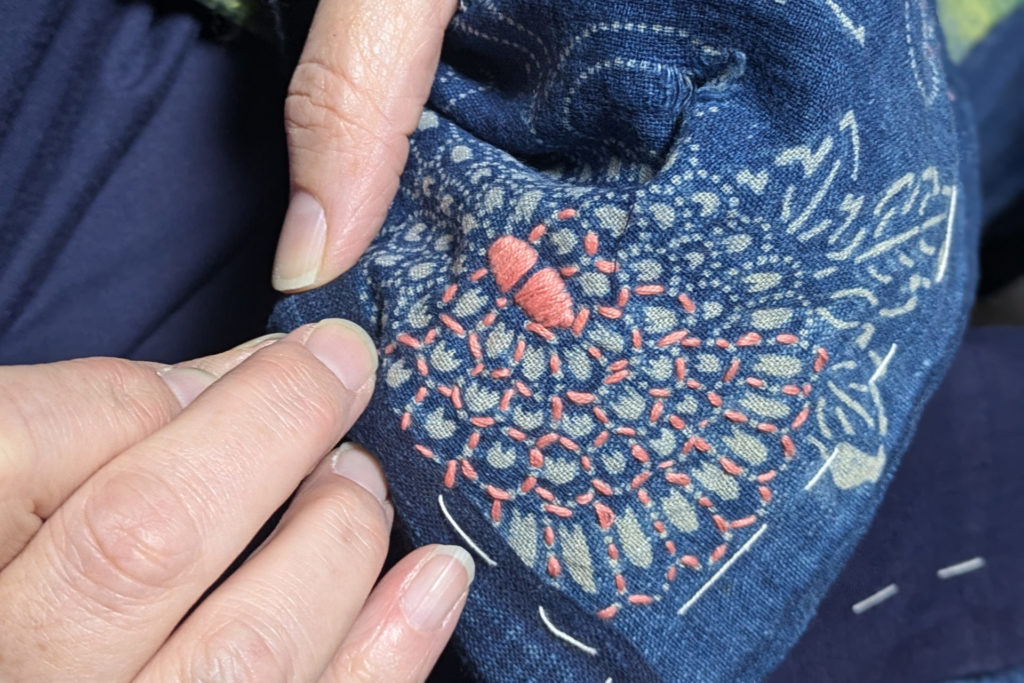
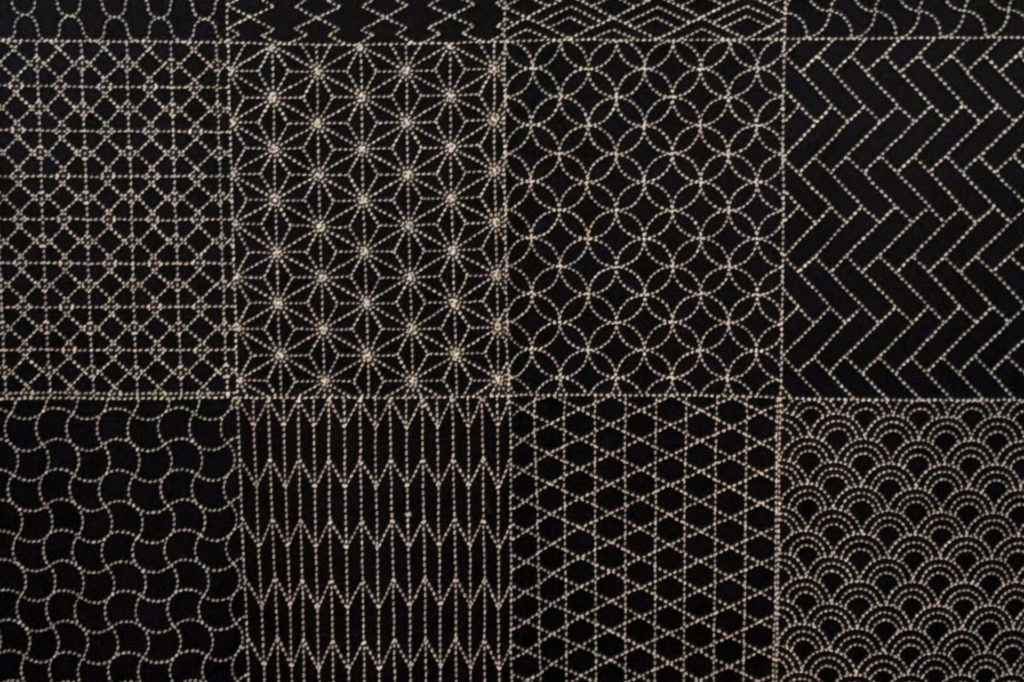
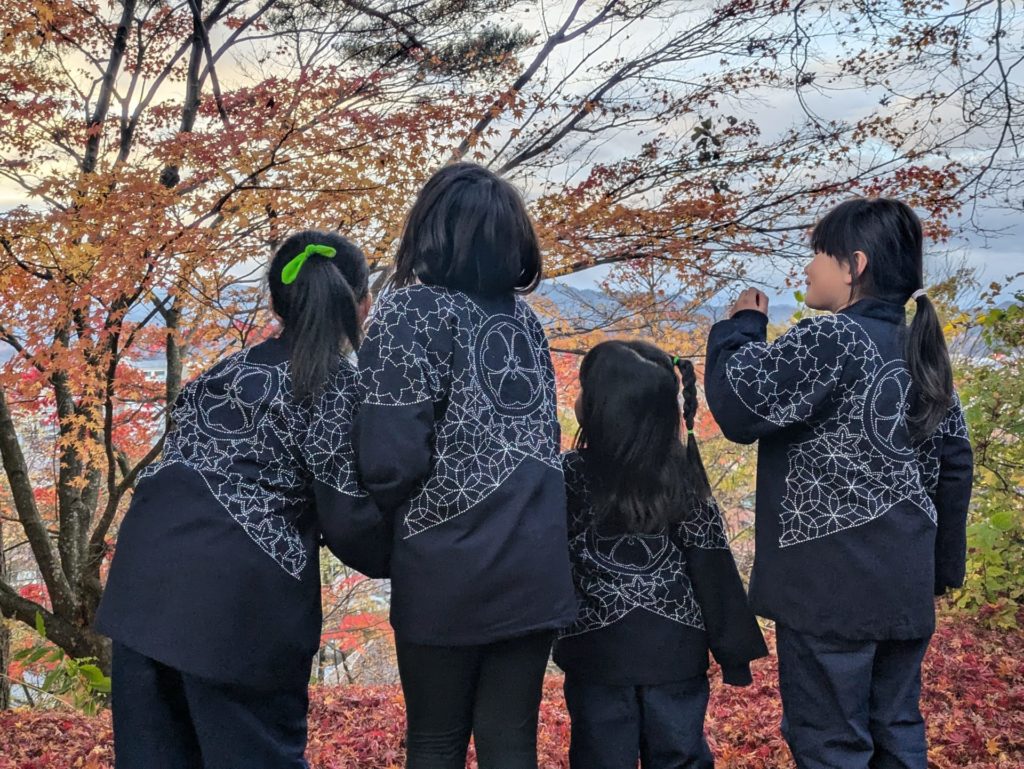
Sashiko is a form of hand- stitching the Japanese had developed hundreds of years ago. I strive to leave this culture to the next generation by sharing the stitching technique and stories behind its history.
I believe the Sashiko is the process of mending, repairing, strengthening the fabric with putting thoughts of the family. Also, it was the Fashion the Japanese tried to enjoy in the limited resource and regulation. There are many “Sshiko looks” fabric available in the market. I hope people start enjoying their own Sashiko by appreciating the fabric they are already in Love.
If you are interested in any keywords below, the information in this website may be beneficial.
Upcycle / Repurpose / Sustainability / Janaese Traditional Stitching / Boro / Nogari / Mingei / Mending / Japanese Hand Made/
Recycle (Upcycle) what you love instead of Replacing it. You will love the item more if you repair it by yourself, with your hands.
Over the years, we have shared Sashiko with people around the world through both online learning and In-Person Sashiko Classes. Online classes continue to be a wonderful way to connect across distance and to learn at one’s own pace.
For those who wish to share the same space, fabric, and quiet rhythm together, In-Person Sashiko Classes 2026 offer another equally meaningful way to experience the same practice face to face. These In-Person Sashiko Classes 2026 will deepen your connection to the craft.
In 2026, Upcycle Stitches will once again offer a limited number of these special in-person opportunities.
Our In-Person Sashiko Classes 2026 will guide you through traditional techniques and the philosophy behind the art.
About the In-Person Sashiko Classes 2026
The In-Person classes are guided by Japanese Sashiko artisan Atsushi Futatsuya and focus on the Core & EsseThe In-Person Sashiko Classes are grounded in the same philosophy that supports our online learning, now experienced through shared physical space and quiet presence at Upcycle Stitches. In these gatherings, participants are invited to move beyond surface technique and encounter the deeper structure of Sashiko as a way of living with cloth, time, and intention.
Through the In-Person Sashiko Classes 2026, participants will be gently guided into:
Traditional needle movement (Unshin) and its natural rhythm
The delicate relationship between fabric, thread, and tension
The everyday mindset behind continuous stitching and repair
Sashiko as a living practice of repetition, memory, and care
These In-Person Sashiko Classes are not designed as quick, project-based workshops focused on finishing a single piece. Instead, they offer unhurried time to slow down, observe, and feel what often becomes clear only through shared presence — the subtle adjustments of hand and posture, the quiet dialogue between fabric and needle, and the rhythm that emerges when people stitch side by side.
2026 Schedule & Registration
Experience the tranquility of In-Person Sashiko Classes 2026 where community and creativity intersect.
To keep this page simple and accurate, all schedules, locations, and registration details are maintained on our official Sashiko Story page. Please refer to the link below for the latest updates:
Our schedule for In-Person Sashiko Classes 2026 will be shared soon, so stay tuned for updates.
Who These Classes Are For
TThe In-Person Sashiko Classes 2026 warmly welcome a wide range of participants, from those taking their very first stitches to those who have been practicing for many years. These gatherings are created as open, supportive spaces where people of all backgrounds can sit together with fabric, needle, and thread, and learn at their own pace.
They are especially suited for:
Those who discovered Sashiko through online learning and wish to experience the practice in person
Beginners who are about to take their very first stitches
Quilters, textile artists, menders, and makers working with cloth in many forms
Returning students who seek a deeper understanding of Sashiko’s rhythm, philosophy, and everyday practice
Join us for In-Person Sashiko Classes 2026 and immerse yourself in the quiet, steady world of hand stitching — where time slows, hands learn through repetition, and each stitch becomes part of a shared moment.
No prior experience is required, and participation in online classes is never a prerequisite. Whether you come from an online class, another textile practice, or complete curiosity, you are welcome to join and discover the living rhythm of Sashiko in person.
One Practice, Many Ways to Learn
Our Sashiko can be learned online. Our Sashiko can be learned in person. Both paths are valid, and both continue to shape the community we share.
The In-Person Classes are simply one more way to encounter the same quiet rhythm — this time, face to face.
If you are curious about the 2026 opportunities, we invite you to visit the official page for full and current information.
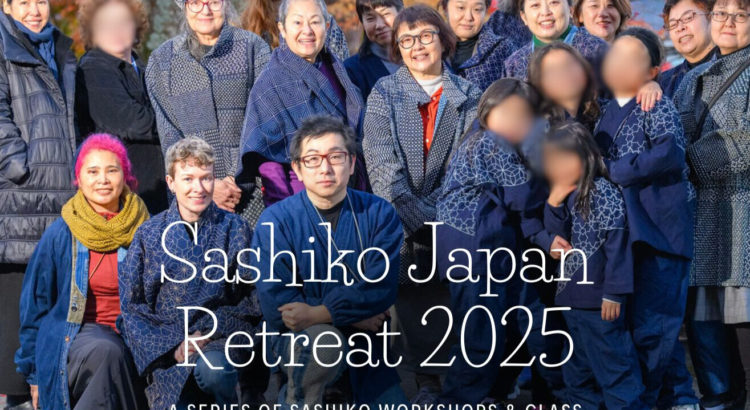
Since the first time I organized the Sashiko Tour to Japan in 2023, it has been my greatest joy to guide my “Sashiko Friends in the World” to meet my “Sashiko Friends in Japan.” Over time, I changed the name from “Tour” to “Sashiko Japan Retreat,” as I realized the word “Retreat” best captures what I truly want to offer.
*If you wish to join, please fill out the Google Form here. It is available on the website above, too.
This retreat is not a sightseeing tour. It is a series of workshops and gatherings that allow participants to meet previously “unknown” Sashiko artisans in Japan, experience the Sashiko they practice, and step into the cultural spaces that usually remain closed to visitors. Such access requires layers of trust. This retreat is possible only because of the long-standing relationships of trust I share with my Sashiko friends in Japan. No tour company or single artisan could make this happen—it is something we can create only as a community of Sashiko practitioners, united by sincerity and authenticity.
Sashiko is more than technique.
And then, what I can teach is just one small part of the whole picture of Sashiko.
Explaining what lies beyond technique—the “more” of Sashiko—is challenging. I could pretend to be a master of all Sashiko, but doing so would betray the trust that sustains our practice. Instead, I invite you to Japan so you may experience that “more” firsthand: the kinds of Sashiko I cannot teach alone, shared by the artisans who continue to live it every day. Over ten days, I will tell stories of my own, and I will translate the stories of my teachers, so that you may hear their voices directly.
If one is truly serious about going deeper into Sashiko—to appreciate what it really is—this is the journey I want you to jump in. Together with my friends, my family, and myself, we will support your path. I often say that the “Core & Essence” workshop opens the door to our Sashiko. A multi-day workshop/retreat then invites you into my space, where I can share all Sashiko that I know. But this Sashiko Retreat goes even further: it opens many other doors—those of my friends, my family, and the wider circle of artisans in Japan. No single person can be “the expert” of the entire picture of Sashiko, but this retreat offers a bridge to meet and experience the diverse realities of Sashiko being practiced in Japan.
In the past, I never advertised these retreats because of the long waiting list. For 2025, however, two seats have unexpectedly opened (due to personal circumstances of the participants who gave up their spots sadly). Those on the waiting list had already made other plans, as I had told them the chances of a seat were slim back in Spring 2025. Many are now preparing instead for 2026 or beyond.
The 2025 Retreat will begin on the morning of Monday, November 17th, and conclude on the morning of Thursday, November 27th. With just three months to go, I hope this message reaches those who feel called to join us for this rare and precious opportunity.
Thank you for taking the time to read this. The detailed outline of the retreat follows below. Please fulfill the Google Form below to notify me either you are ready to join the Sashiko Japan Retreat 2025, or interested in the further Retreat in 2026 and after.
–
*The itinerary below is part of the Sashiko Japan Retreat 2025. Please note that both the contents and schedule are subject to change for the 2026 retreat and beyond.
**Also, please be aware that a 2026 retreat is not guaranteed. The 2025 Sashiko Japan Retreat will take place without question. However, depending on the number of participants, this 2025 retreat may be the last one I can offer for some time. I will never stop offering this experience, but I may need to pause and reorganize my plans and strategy before hosting future retreats.
–
Heart of Boro – not just a “whatever” patchworking
Throughout the Retreat, you will spend a great deal of time with my mother, Keiko. As many of you may already know, she is the creative force behind the Sashiko Story scene. I, of course, enjoy stitching—as you may have seen on YouTube—but without her, many of the most significant Sashiko pieces would never come to life.
Keiko is an artist (although I personally hesitate to call Sashiko “art” just yet). Unlike my structured approach to teaching—designed to help students learn step by step—her way of sharing Sashiko is centered on having fun. This approach assumes a basic foundation of Sashiko and Unshin, which is why my Core & Essence workshop is a prerequisite for joining this Retreat.
One highlight will be a day spent with her remarkable collection of Kofu (Japanese vintage fabrics). Together, we will “play” with these fabrics—stitching and experimenting to experience what I call “Boro To Be” fabric. Boro is not a technique, nor is it simply patchwork done at random. It is a status of fabric: material that has been continuously stitched and used until it embodies the life and stories of its maker and owner. In this workshop, we will bring vintage fabric back to the stage, giving it new purpose and the possibility to become Boro as it is stitched and used again.
There is no right or wrong in Keiko’s Sashiko. What she offers is her wisdom, her experience, and her joy. This one-day workshop will introduce you to the true heart of Boro—something that is often deeply misunderstood in today’s Sashiko world.
Open a door to prepare many geometric pattern for Sashiko
Today, it is easy to find countless Sashiko kits that come with fabric already pre-printed with patterns and even dotted stitch guides. There are also many “Sashiko templates” or stencils available—on Amazon, on Temu, and elsewhere—made by companies who recognize that Sashiko has become a strong enough trend to invest in mass production.
There is nothing inherently wrong with using pre-printed fabric or stencils. They can be convenient, enjoyable, and even inspiring. However, for those who wish to go deeper into the heart of Sashiko, it is essential to learn how to prepare the patterns by hand, as Japanese practitioners did before printing technology and ready-made stencils existed.
During the retreat, we will spend a day with a rising Sashiko artisan who has gained many admirers on Instagram for her beautiful Sashiko—not only the stitching itself, but the entire process. She will teach us how to prepare patterns directly on fabric in the size and form we desire. Following her principles, you will discover how to draw virtually any geometric pattern onto fabric with your own hands.
This will also be a chance to witness the elegance of “beautiful Unshin”—not only the final stitched piece, but the graceful movement of hands, needle, thimble, and fabric working together. Though Sashiko is “just stitching,” the refinement and sophistication of the process are extraordinary.
This day will open the door to becoming a true Sashiko artisan.
For clarity: I would not consider someone an “artisan” if they rely entirely on templates or stencils to prepare their patterns. Of course, one may choose to use them, but if they cannot work without them, it becomes a harmful oversimplification of the culture.
Modern Kogin, and then more Modern Kogin
Koginzashi and Hishizashi are an important part of the Sashiko tradition, developed primarily in the northern regions of Japan. Their approaches to stitching are quite different from the Sashiko I practice, shaped by unique geographic, socioeconomic, and historical factors. I am far from being able to call myself a teacher of Kogin or Hishizashi.
During the retreat, we will visit a master of Kogin—especially Modern Kogin—in Tokyo, someone who has dedicated more than half a century to this practice. Under her guidance, we will have the opportunity to learn Koginzashi directly from her experience.
We will then meet another Kogin practitioner who represents a more “modern” interpretation of the tradition. Her work adapts to the needs of today’s society, evolving into a new form of craft that blends elements of the Sashiko I practice with Kogin and Hishizashi.
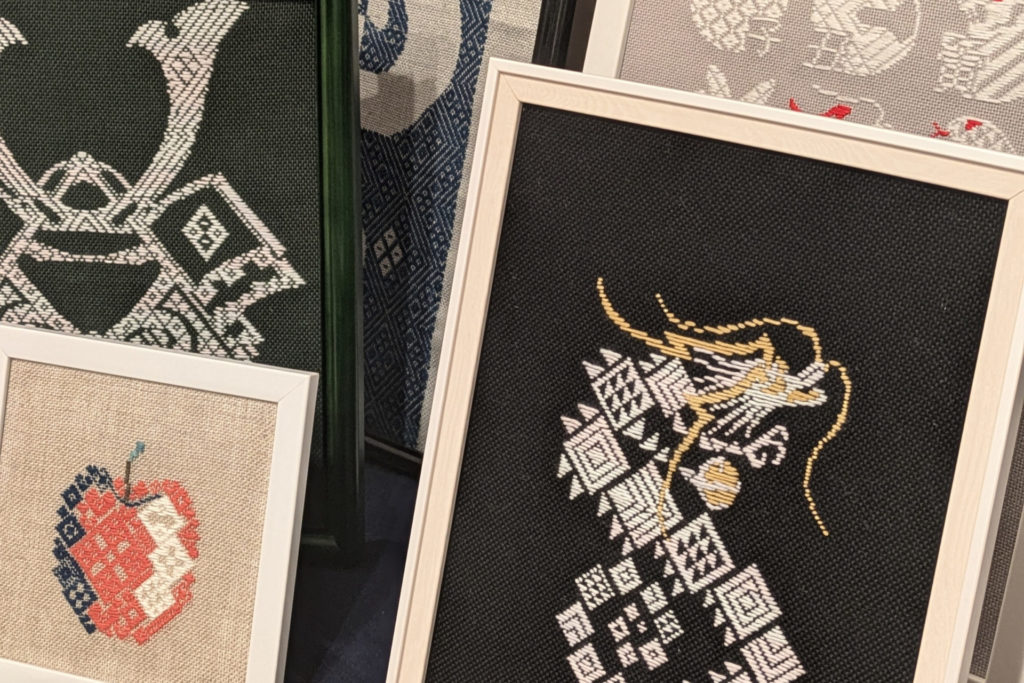
I do not have many words to fully describe this experience, because any description risks being superficial compared to what you will see with your own eyes. The photographs here may give you a glimpse, but the experience you will have in Japan will be far more meaningful than anything I can write.
Cute Sashiko – above what Atsushi can offer
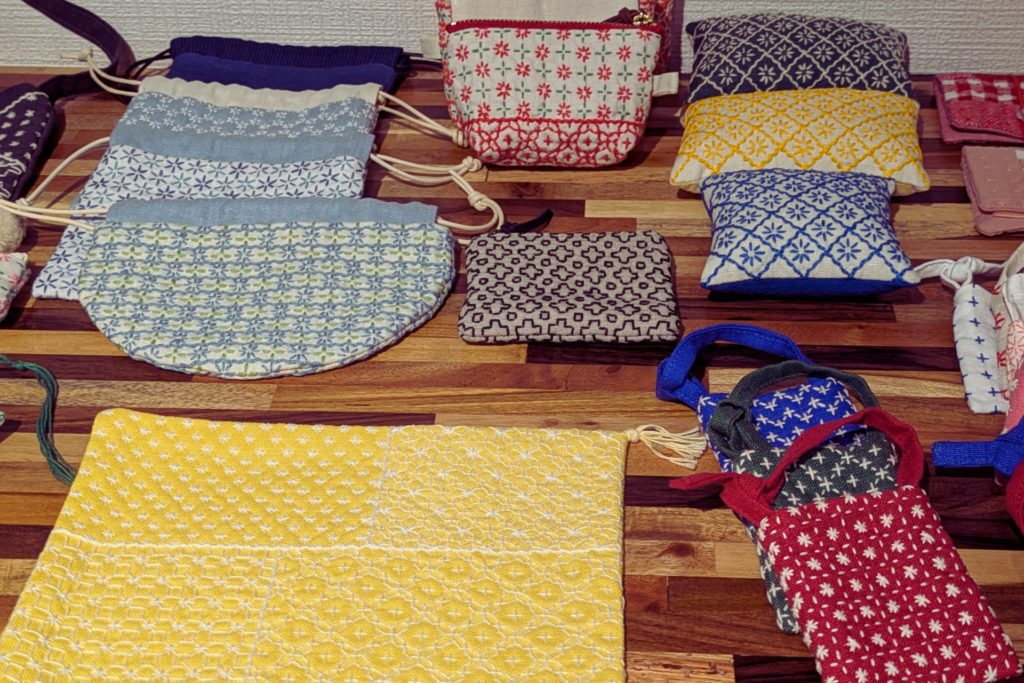
In today’s trend of Sashiko, reflecting modern preferences and needs, we cannot ignore the growing popularity of colorful and playful designs—often expressed through Hitomezashi. This is not my strength, as my own preference is quite fixed—like someone who insists on having only coffee every morning.
Instead of me teaching, we will dedicate a day to learning “Cute & Colorful Sashiko” from a wonderful teacher. Out of respect, I cannot share much information publicly, as this teacher prefers not to be introduced on the internet. However, participants will be pleasantly surprised when they meet her. I am proud to call this artist a “Sashiko friend,” and it is my sincere pleasure to offer a glimpse into the many evolving expressions of Sashiko within Japan today.
From me, you will see the past of Sashiko. From these teachers, you will create the future of Sashiko.
–
–
In addition to the workshops, we will stay in unique and memorable hotels, ryokan, and guesthouses that I have researched and enjoyed during previous retreats. These are not the most luxurious accommodations, nor are they impersonal chain hotels with little character. Each place—whether a hotel, ryokan, or Airbnb—has its own personality and charm, adding to the richness of the journey.
I have also put great care into preparing our meals. At each location, we will enjoy some of the finest cuisine available, but more importantly, we will share deeply local meals made possible through the help of our friends. Fine dining can be arranged simply with reservations and budget, but what I hope to offer is something more meaningful—an experience of both elegance and authenticity. We will enjoy both worlds.
And lastly, I will be with you at all times throughout the retreat. You are welcome to ask me anything, at any moment—whether to confirm your Unshin, to hear cultural stories, or even to share something personal. This is my way of inviting you into my own fragile yet important space, where I can share what Sashiko truly means—for me, for us, and for the Japanese people.
This article is just a glimpse into the ten days we will spend together. I hope it encourages you to step into this rare experience. I look forward to meeting you, seeing you, and sharing time with you.
For Sashiko stitching, preparing the pattern on fabric is straightforward. In fact, as shown in the 6 Minutes Video of Transferring Kamon Pattern for Sashiko, transferring a Kamon pattern takes only about six minutes with the right tools.
Here’s what you’ll need & exactly what I used on the video:
Carbon Paper (chalk paper with a carbon-coated side to transfer the pattern)
As the video shows, it’s quite simple and doesn’t require much skill. All you need are good tools and supplies to make sure your time isn’t wasted. This is just the process of preparing the pattern, not Sashiko itself. However, it’s a very important step to fully enjoy Sashiko.
General Tutorial on “How to Transfer the Pattern on Fabric for Sashiko”
Learning “How to Transfer the Pattern” is crucial, no matter the type of pattern you’re working with. While some geometric patterns can be prepared without this step, I encourage all Sashiko practitioners to master the process of using transfer paper and the appropriate tools. This skill ensures that any pattern can be accurately prepared, enhancing the quality of your Sashiko stitching.
For more detailed guidance, you can find a separate article I wrote in 2017 below.
A common question I receive from those interested in Sashiko is this: “Which is better—using preprinted Sashiko fabric or transferring patterns onto the fabric yourself?”
In my experience, transferring the pattern yourself is the most rewarding approach, and I always recommend it. Why? The process not only enhances your skill but also allows you to take full control over your project. Sashiko, at its heart, is more than the act of stitching. It’s a deeply personal journey of creating something uniquely yours, selecting and arranging patterns that truly resonate with you.
When you transfer the pattern by hand, you add a personal touch that simply can’t be achieved with preprinted fabric. The process is not overly complicated and can be done with basic materials like transfer paper and tracing tools. By preparing your own pattern, you engage more fully with each part of the Sashiko process, transforming a simple fabric into something entirely your own.
In embracing this step, Sashiko becomes more than just the final stitched design—it’s the entire process, from preparation to completion. This is why I encourage anyone, from beginners to advanced practitioners, to learn and appreciate the art of pattern transferring.
Other option is to purchase the fabric with pattern preprinted.
While I highly encourage you to learn how to transfer patterns onto fabric by following “A Video of Transferring Kamon Pattern for Sashiko,” there’s nothing wrong with using pre-printed fabrics. When working on a large piece with a complex geometric pattern, I understand that preparing the entire pattern yourself can feel overwhelming.
To make things easier, we offer fabric with pre-drawn patterns, created using a silkscreen technique and printed with water-washable ink on indigo-dyed cotton—the ideal fabric for Sashiko. These pre-printed fabrics provide a convenient way to practice Sashiko stitching, particularly with Unshin.
One suggestion I’d like to make, however, is to avoid pre-printed patterns where stitch sizes are already defined. Such markings can disrupt the natural rhythm of Sashiko stitching. Instead of following printed dots or lines that dictate stitch size, try to find your own rhythm and style in each stitch. This approach will allow you to truly connect with the art of Sashiko and make the process
The Best Sashiko Thread is more than just a material—it’s the foundation of beautiful, authentic Sashiko stitching. While many focus on mastering the intricate patterns and techniques of this traditional Japanese art form, one critical element often gets overlooked: the thread itself. Using the wrong thread can hinder your progress, but choosing the right one can elevate your work to a whole new level.
In this article, we’ll explore why the best Sashiko thread isn’t just a minor detail, but a game-changer in your stitching journey. We’ll explain how Sashiko thread differs from regular sewing or embroidery threads, and why it’s essential for achieving smoother, more durable, and visually stunning results. Whether you’re just beginning your Sashiko journey or are already experienced, selecting the right thread will unlock the true beauty of this art form.
Let’s dive in and discover how the best Sashiko thread can transform your work.
Why the Right Sashiko Thread Makes All the Difference: A Guide to Elevating Your Stitching
One of the most common questions I receive from Sashiko enthusiasts is about the thread: “Do I really need to use a specific thread for Sashiko?” and “What makes Sashiko thread different from regular threads?” These are excellent questions because, at first glance, it might seem like thread is just thread. But in reality, the thread you use can make or break your Sashiko project.
I’ve addressed this in-depth on my website (link at the end of this article), but let me share why choosing the right Sashiko thread is essential—and how it can transform your stitching.
A Story of Frustration Turned Success
Years ago, during one of my Sashiko workshops, I had a student who was excited to dive into the craft. She followed the techniques carefully, but her results were disappointing. Her thread kept fraying and breaking, making her stitches uneven and inconsistent. No matter how hard she tried, something wasn’t quite right.
After watching her struggle, I handed her a spool of authentic Sashiko thread, and the results were immediate. Her needle began to glide effortlessly through the fabric, the stitches came out smooth and even, and the beauty of the Sashiko patterns emerged. She was stunned by how quickly her work transformed—all because of a simple change in thread.
Why Sashiko Thread Is Different
So, what exactly makes Sashiko thread so special?
Unlike regular embroidery or sewing thread, Sashiko thread is designed specifically for the unique demands of this traditional Japanese stitching technique. Here’s why it matters:
Thickness and Strength: Sashiko thread is thicker and stronger than ordinary thread. This helps create bold, visible stitches that stand out and hold up over time. Regular thread can’t provide the same durability, especially when working with dense or repetitive stitching patterns.
Softness and Texture: The softness of Sashiko thread allows it to glide through fabric without causing unnecessary friction. This reduces wear and tear on the fabric and creates smoother, more uniform stitches. Ordinary thread, on the other hand, can be too harsh, fraying easily and making the stitching process frustrating.
Harmonious Results: Sashiko thread is designed to work in harmony with the traditional fabrics often used in Sashiko, like indigo-dyed cotton. This harmony helps achieve the characteristic “look” of Sashiko—an interplay between strong, clean stitches and beautifully textured fabric.
The Difference in Your Stitching
Using the right thread makes an undeniable difference. You’ll immediately notice that:
Your stitches are more even and consistent, allowing the patterns to emerge clearly.
The thread holds up over time, ensuring the durability of your project, whether it’s a small decorative piece or a larger textile.
Your overall stitching experience becomes smoother and more enjoyable, as the thread flows easily through the fabric, eliminating the frustration of constant fraying or snapping.
Why You Should Choose Authentic Sashiko Thread
If you’re serious about Sashiko, using authentic thread is not just a suggestion—it’s an absolute must. Without it, you miss out on the true potential of this beautiful art form. Authentic Sashiko thread connects you to the centuries-old traditions of Japanese craftsmanship, allowing you to achieve the best possible results in your stitching.
That’s why I’ve carefully selected and curated a collection of the best Sashiko threads available. These threads are made to the highest standards, ensuring they meet the specific needs of Sashiko stitching. Whether you’re just starting your Sashiko journey or you’re an experienced stitcher, using authentic thread will transform your work, helping you achieve cleaner, more professional results.
Elevate Your Sashiko Stitching Today
Are you ready to take your Sashiko projects to the next level? Don’t settle for ordinary thread that limits your creativity and frustrates your process. Order authentic Sashiko thread today and experience the difference firsthand.
Visit our store to explore the best Sashiko threads and elevate your stitching to new heights. Whether you’re working on intricate patterns or simple designs, using the right thread will unlock the full beauty of Sashiko. Don’t wait—make the switch and transform your Sashiko work now!
I’ve been reflecting for a while on whether it’s the right choice to organize this kind of campaign (Sashiko Japan Retreat Support Page) — asking for support to enrich our experience while in Japan. On one hand, it feels a bit uncomfortable (and even embarrassing). On the other hand, I’ve been facing more challenges than I expected, particularly with fewer students enrolling in my Sashiko classes for 2025. To be honest, I’m not entirely sure why this is happening. Could it be that I’ve shared too much content for free online, and now many feel satisfied without diving deeper? Could my generosity in teaching be working against me? Still, I have no regrets about sharing what I have—it’s part of my philosophy, and something I believe in deeply.
This campaign on Give Butter is about supporting “our” side of the Sashiko Japan Retreat, but more specifically, it’s to help with personal time we will spend with my family involving my daughter—who will be visiting Japan for the first time since the pandemic. Please take a moment to check out the Give Butter page I’ve prepared after much consideration. I really appreciate your time & consideration.
More Story behind of “Sashiko Japan Retreat Support Page”
For this 2025 Sashiko Japan Tour (Retreat), I’ll be bringing my daughter with me to Japan. Although Japan is part of her heritage, this will be her first visit. She’s now 9 years old, and the reason she hasn’t been able to visit before has been purely financial. Before the pandemic, she spent her summers with her grandparents in Israel, which made planning two separate international trips in one year nearly impossible.
Taking my daughter with me this time is a decision rooted in family needs—primarily to support my spouse, who works full-time. Originally, I hadn’t planned to offer another Sashiko Japan Retreat until my daughter was old enough to take care of herself, especially on nights when my spouse might have to work late or be on call. I even mentioned that the next retreat wouldn’t be for another 6 to 10 years. However, several Japanese Sashiko artisans advised me that waiting that long might be too late, as many Sashiko masters are aging, and we don’t have much time left to share and preserve the unique form of Sashiko we practice.
After discussing the risks with the participants of bringing my daughter along, I decided to balance offering the Sashiko Japan Tour with the responsibility of caring for my family.
However, things took an unexpected turn after we had already booked our flights and accommodations. My spouse made the difficult decision to step down from her job. While this has significantly reduced her stress, and she’s now more able to care for our daughter, it has also required us to make some financial adjustments. Of course, I fully support her decision—her health and well-being are far more important.
With all of this in mind, I’ve decided to launch another “Give Butter” campaign, asking for your support. I plan to use your contributions to help immerse my daughter more in Sashiko culture. Right now, she doesn’t have much interest in Sashiko or Japanese crafts, but I hope this experience in Japan will give her a connection to it—and maybe, just maybe, she’ll begin to appreciate it.
This campaign also has a second purpose: to involve my friends, students, and followers in this unique and exclusive retreat. I’m not sure how often I’ll be able to offer these tours in the future, so I want to make this experience as inclusive as possible. For those who contribute to the Give Butter campaign, I’ll be sharing personal photos and stories on a designated website. Last year, the postcards from Japan were a big hit, so I’m excited to send them out again this year as a small token of my appreciation.
Once again, thank you very much for your consideration to this. It is a bit embarrassing to do so… at the same time, it is my responsibility to preserve the Sashiko we have been practicing, and I “can” ask for the support when I need a bit of help to push the vechicle to reach to the Goal.
Thank you once again for being part of this journey with us.
It is my sincere pleasure to re-join the QuiltCon 2025 as a Faculty. This page is for those who plan to attend QuiltCon 2025 Sashiko Workshops & Lecture, “Core & Essence”, “Apply Hitomezashi to our Ordinary” and “Aesthetics of Stitching from a Sashiko Artisan – Why Do We Stitch“. Please find the details below to see what you can expect in QuiltCon 2025 Sashiko Workshops & Lecture.
For those who have the registration confirmation, I will prepare the support page below.
*The Support Page will be available later when it gets close to QuiltCon
*If you do not have a registration confirmation to join the QuiltCon 2025 Sashiko Workshops & Lecture, please contact MQG for the possible waiting list. In the previous QuiltCon, there were a few last minutes cancellation, and there may be a chance for you to join this year. Also, I offer Online Sashiko Class as well as a few In-person Workshops (for 2024 & 2025). Please check each articles for the details. Thank you.
*I have a feeling that QuiltCon 2025 will be the last QuiltCon I teach Sashiko [Core & Essence]. This is my 5th year to teach the exact same workshop, and I find it quite rare to repeat the same contents. The Sashiko Workshop [Core & Essence] is the fundamental of pretty much all of my teaching in Sashiko – like teaching how to use a specific Japanese knife & cutting board before sharing some recipe for Japanese cooking. It would be difficult to create another contents for those without completing the [Core & Essence]. I am happy to consider re-applying to QuiltCon 2026 when I have a list of interest. I respect the QuiltCon’s philosophy, goals and policy – and I understand that it isn’t the best match to keep offering something same repeatedly. If you couldn’t register yourself for QuiltCon 2025, and yet wish to take the [Core & Essence] in the future QuiltCon, please fill out the Google Form below so that I will consider the possibility. Thank you.
*The Support Page will be password protected after the QuiltCon, and I will send the Password for those who attended the workshop. The offer available on the Support Page are only available to those who sign up & purchased the Special Supply Package. Misuse of any offers are subject to the actual price adjustment. Thank you for your understanding!
QuiltCon 2025 Sashiko Workshops & Lecture
In QuiltCon 2025, I offer 2 kinds of Sashiko Workshops & Lecture. One Workshop is my signature workshop [Core & Essence] and Another Workshop is my new challenge [Sashiko: Apply Hitomezashi to our Ordinary], which doesn’t have any prerequisite to join. The Sashiko Lecture is about “Aesthetics of Stitching from a Sashiko Artisan – Why Do We Stitch.”. In this page, I explain what you can expect in each Workshop & Lecture, which includes information about preparation may be required.
QuiltCon 2025 Sashiko Workshop [Core & Essence]
In our tradition, Sashiko is NOT about making perfect (or Inperfect) stitches. It is all about moving (trusting) a needle comfortably while communicating the fabric. Unfortunately, the current trend of Sashiko is missing one important aspect of Sashiko. In this “Core & Essence” workshop, I will teach you the core technique of our Sashiko so that you can start focusing on communication rather than judging each stitches you make.
It is extremely important to take this workshop before jumping in to any of other workshops we offer. There are a few Japanese terms that the participants need to memorize (not so many & no exams or whatsoever, but knowing them is important).
On Instagram and Facebook, I often say: Sashiko is NOT ◯◯. This workshop “Core & Essence” will give you the answer what Sashiko is for you while you learning new techniques.
*This workshop is not a type of “Let’s Enjoy Sashiko Togeher” workshop. It is one-direction learning experience for you. The participants are required to stitch a lot. They may have to go through some “uncomfortable” stitching experience (due to new muscles they use). Sometimes, it may require some mindfulness in an eye-opening experience. Please do not be scared or worried, however. I will do everything to help you to “experience” and “start enjoying” the Sashiko we practice today.
*There is NO prerequisite for this workshop. No experience in Sashiko is necessary. If you have never touched the hand-stitching needle, please try to learn how to “thread” the needle, or how to use the threader (videos are available on my Youtube). On the other hands, if you think you already know about Sashiko, please try to be as open-mind as possible. What I teach in this workshop is probably different from what you already know. There is no such a thing as “Right and Wrong” in Sashiko: and I will add another perspective of Sashiko in this workshop.
It is extremely important that everyone has the exact same materials & tools to pass down the Core & Essence within 6 hours. Please purchase the special package below before the QuiltCon 2025.
What to bring to Sashiko: Core & Essence.
The Special Package above is all you need to enjoy the Sashiko: Core & Essence. If you choose to receive it to your home, please bring all of the contents inside.
The following list is something maybe helpful for you to bring & prepare:
Masking Tape or Bandage to protect the nail from scratching by needles.
It may a good idea to cut the nail on the dominant hand (the hand with the needle). One can learn Sashiko with long nails, but it may be an obstacles in the first trial.
Sashiko Workshop: Apply Hitomezashi to our Ordinary
Hitomezashi is a popular style of Sashiko to apply our Ordinary Stitching & Fashion. This workshop introduces a standard process of enjoying Hitomezashi. Starting from learning how to prepare the grid on the fabric, how to “create” the Hitomezashi pattern, stitch Hitomezashi & apply it to a favorite Quilt/Garment (stitching on Used Denim or thin cotton fabric is Recommendation).
Unlike another Sashiko Class “Core & Essence” Atsushi offers, this workshop does NOT include a strict learning & stitching practice. A participant can use any thread & tools that they want to use. You may purchase a package of materials prepared, but it is not required to purchase.
The Objective is to learn how creative we can be while appreciating the Cultural Significance of Sashiko by approaching both visible & invisible mending while maximizing the joy of Hitomezashi. Experience in Sashiko: [Core & Essence] will be a great help to maximize this workshop, but not required.
Cottons Thread (Preferably Sashiko Thread, but any threads are fine) – (Recommendation)
Needle (Preferably Sashiko Needle, but any needles are fine) – (Recommendation)
Several Small Swatch of Fabric, about the size of 4” x 4” (No bigger than 7” x 10” and No smaller than 3” x 3”). Just in case, please prepare – several kinds of fabrics. This will be used for the “Patches”. Any Cotton Fabric would be fine, but this fabric is our recommendation for Sashiko including Hitomezashi.
A garment (or any other fabric items) that you would like to attach the Sashiko Stitched Swatch(es). It can be with some damages such as torn or a hole – or without Damage is perfectly fine, too. If there is enough time Atsushi would also like to cover attaching the patches
Chalk Pencil, or Fabric Marker. Please choose the one which you can draw on the fabric you will bring. Fine Point pen/pencil is recommended. It will be helpful to have 2 or more colors, if possible.
Masking Tape
A Ruler to draw straight lines. Please bring longer/bigger Ruler than the fabric you prepare.
A tool to cut the thread (to the ideal length) – A pair of Scissors if you want to prepare a skein of Sashiko Thread for the optimal usage (I believe QuiltCon has some Scissors available).
US Letter Size Card Stock Paper with 5mm Grid Pattern Printed (PDF will be provided via email). Preferably the card stock thickness of 199 GSM or more. Please bring several copies if possible.
Please check the article for “What is Recommended Supply” (Preparing).
The Optional Supply Package with Required & Optional Supply (excluding scissors, thread clipper and Garment you want to stitch on) is available for purchase.
These are the Supplies & Tools you may bring. Depends on the level of your stitching, these items may be helpful in the Workshop.
Thimble (Preferably the one from Core & Essence) – (Recommendation)
Basting Thread
Pencil Sharpener for Chalk Pencil
Threader
Extra Card Stock Papers with Grid on, with changing the Grid Size.
Any Tools to make stitching comfortable. ex) an embroidery hoop if one feel comfortable stitching with it. I recommend non-stretchy items. Avoid T-shirts or sweaters.
Required Preparation
Please cut fabrics you want to stitch on to the size about 4″ x 4″, no bigger than 7” x 10”, and no smaller than 3” x 3” (change the size based on your preference). Please bring threads in a form that you can use right away.
Sashiko Lecture: Why Do We Stitch?
Aesthetics of Stitching from a Sashiko Artisan – Why Do We Stitch
Aesthetics can be defined as one’s appreciation of beautiful things. We choose to stitch in a society where we can purchase something already stitched. Is there any link between our choice & Sashiko’s Aesthetics? What is the philosophy behind the stitching for a Sashiko Artisan (Atsushi) who has been hand-stitching throughout his life? Why does he even still practice Sashiko?
This is the Lecture introducing Atsushi’s Sashiko. It starts from his childhood to Today’s form of stitching why he is teaching Sashiko in English. We hope to introduce another way to approach stitching with another way to embrace the aesthetics to fully appreciate Sashiko in Western Quilting World. Why Do You Stitch? Atsushi is ready to share why he stitches.
Learning someone’s Aesthetics from different cultures will be the bridge between Appropriation to Appreciation of other cultures. There is a person who decided to dedicate all of his entire life into Sashiko, and this is his Story to share the Aesthetics of Stitching as Adding Stories to our own Fabrics.
About Recommended Tools for our Sashiko
The Special Supply Package for the [Core & Essence] Workshop includes everything the participants need in the workshop. There is no need to prepare thread, needle, thimble or fabric for learning Sashiko in this workshop. In order to avoid unfortunate misunderstanding, for [Core & Essence] I require everyone to use the exact same tools & supply.
That being said, there are a few recommended tools for Sashiko, which is NOT necessary yet very useful when you wish to continue Sashiko stitching. You can find another article here for Recommended Tools.
In the Sashiko we practiece, we try to make both side of the fabric as the “finished Side.” To make it easy to cut the thread left over, this thread clipper is a good idea to have.
Our Sashiko Thread is quite easy to get tangled when it is not properly handled. This Bobbin Paper is designed to keep the Sashiko Thread in a good shape for a travel or heavy usage.
It is important to learn how to prepare the pattern by ourselves as Sashiko Practitioenrs. One way to prepare the fabric is to “transfer”. This paper will help us to do better.
Recommended Items are available as a Set Deal for Quiltcon 2025
General Information for the Recommended Tools & Supplies for Sashiko Stitching
I am here to Support
After receiving the participation confirmation, if you have any questions about QuiltCon 2025 Sashiko Workshop “Core & Essence”, please contact Atsushi. I am happy to answer any questions or worries prior to the workshop.
Your question may be someone’s question, and I will share the question and answers here on this website (of course, annonymously).
I am looking forward to meeting you in the QuiltCon.
Sashiko In-Person Workshop Schedule 2025 is now available, and we are thrilled to continue offering these workshops throughout the coming year. We sincerely appreciate your interest in learning Sashiko with us. Below, you will find all the detailed information regarding the 2025 schedule.
This post summarizes the workshops that Atsushi will be offering in 2025. We are intentionally limiting the number of workshops to ensure each participant receives an enriching and thorough experience. Due to demand, these workshops can fill up quickly based on location and timing. Once they are fully booked, I am unable to manage the participant list. If you see an available spot, we encourage you to register as soon as possible.
If you have any questions about registration or other administrative details, please contact the hosting organization or studio directly, as they will provide you with a clear understanding of what to expect.
*For those eager to start learning Sashiko now, rather than waiting for an in-person workshop, I highly recommend considering the Sashiko Online Class (2024–2025). Many participants have shared positive feedback, stating that the online class provides the same deep understanding of what Sashiko truly is. Some even prefer it, as they can learn at their own pace. I am always available virtually to support your Sashiko learning experience.
QuiltCon 2025 (Phoenix, AZ) – Feb 20th & 21th, 2025
It is another pleasure to be a faculty in QuiltCon again. This year, I will be offering Sashiko Workshop [Core & Essence], a short Version titled [Apply Hitomezashi to your Ordinary] (In-Person Version similar to Domestika Course), and a Lecture about [Why we stitch (Sashiko)].
Please check the detail below for the possible participation to Quitcon 2025 & Sashiko Workshops & lecture. (Waiting for Registration Opens).
Aya Fiber Studio (Stuart, FL) – March 7th to 9th, 2025
3-Days In-Person Workshop has become my Standard & Best Style of Teaching the Sashiko we practice, starting with [Core & Essence] and following [Application & Practice]. This 3-Days Workshop will offer fun, educational, and intensive 18 ~ 21 hours of stitching together. Plan your time in beautiful beach in FL with Sashiko.
Sashiko introduced in English often focused on “Outcomes” too much without acknowledging the Japanese mindset behind Sashiko Practice. In order to fully appreciate the culture, one needs to learn the “new muscle memory” that is quite unique to many western style stitchers. This 3 Days workshop will keep encouraging you to learn something new from both technical & mindset perspective. With receiving many positive feedbacks, we are confident that this will be an eye opening experience for you.
Madeline Island School of the Arts (La Pointe, WI) – July 2025
This is my first time to offer 5-Days Workshop. In a beautiful Campus of MISA with an appreciation to the Spiritual feeling, we will invite you to fully enjoy Sashiko. I decided to call it Sashiko Retreat.
It is quite interesting to see Sashiko being famous as a word to express “Visible Mending”. It is true that Mending is a big part of Sashiko – however, they stitched to make fabric stronger so that they can avoid the mending until the last moment. For that, Sashiko is a word for “Invisible Mending”, yet “stitching/mending” itself can heal us regardless of the result.
Sashiko is NOT similar to Zen at all, although Stitching can bring us Zen-like outcome. While explaining the difference between Zen and Sashiko, I would like to offer the realization of outside of Dualism & Western Value System.
*The contents are very similar to In-Person 3 Days Workshop, starting with [Core & Essence] and following to [Application & Practice]. You are always welcome to join even after the In-Person 3 Days Workshop & a few participants have participated the workshop as a repeater & found themselves in learning more. Please be reminded, though, that the 5-Days Workshop is composed based on [Core & Essence] and [Application & Practice].
No Workshops near your place? Invite Atsushi to Your Place
Please consider bringing Atsushi to your Group (or even to you as a private course) if you do not find a ideal location & time for you to join Sashiko In-Person Workshop Schedule 2025. Depends on the size of your group & location, this may be the best arrangement for you. Please take a look at the article below & contact Atsushi for the availability.
In most cases, when you have me for an individual group, it will be a Day workshop. I will do my best to make the day memorable & something special. Sashiko is a stitching in Ordinary, but I am confident that I can make the day extraordinary with sharing our ordinary.
If you are an organizer wishing to offer Sashiko Workshop with Atsushi to add Sashiko Workshops to your program, please check the “Pricing Benchmark” PDF from the link Above.
In last 7 years of experience, we have never experienced the case of “Cancellation” due to the lower numbers of participations (below the minimum enrollment). In fact, the workshop will sell out pretty quickly especially when it is the first time for the organizer to have me.
In the “New Normal” after the pandemic, many things move to “Online”. In this trend, I have strong respect for those who maintain the physical locations as Studios and Museum to offer In-Person workshops. It is my intention to contribute to your place with the best Workshop Experience.
Sashiko Online Class (24~25)
Sashiko Online Class is available for those who would like to start learning Sashiko “Right Now” from your own house/room. After offering Sashiko Workshops over the Internet for a while during the Covid-19, I am confident that I can deliver the same message & learning experience via Sashiko Online Class. I “restock” Sashiko Online Class each month, based on the numbers of participants who signed up for the specific period. If you find it available, there is no need to fulfill the waiting list.
I am looking forward to meeting you online!
More to Come for Sashiko In-Person Workshop Schedule 2026
I hope that I can keep offering the workshop in the year of 2026. For the latest information, Please follow Instagram, Business for @UpcycleStitches and Sashiko Stories for @SashikoStory for the latest update!
This week, I plan to have Sashiko Workshops & Sashiko Lecture at Bennington College in VT. It is my first time to offer the Sashiko Workshop & Sashiko Lecture in an academic setting as an invited guest lecturer. The Professor, J Stoner Blackwell, had invited me to such a honorable opportunity to share the Sashiko We have been practicing. They joined the Sashiko Workshop [Core & Essence] at Loop of the Loom in NYC. As someone who teach, it is the biggest reward that they contacted me to share their experience to their students & community after the initial workshop.
This visit will be consisted with 3 parts, (1) Sashiko Workshop to their students in Art Department (2) Sashiko Workshop to the local community (Open to the public with workshop fee), and then (3) Sashiko Lecture at Bennington College (Open to the publich For Free of Charge).
The Sashiko Workshop [Core & Essence] is very structured, and there aren’t much I can modify. In contract, as I received 2 hours for the lecture, I am planning a lecture that I can choose based on the reaction in the auditorium. I don’t really know who will be the audience… the students or artists from community… or even faculty…?
Bennington College has a quite beautiful mission. I share it below & I hope that I can meet their expectation.
In 1932, Bennington was founded on the belief that the education most worth having is the one you create for yourself. The College does not require students to fulfill a set of ready-made requirements; instead, it challenges them to discover their own intellectual identity and to design an education that will help turn them into the person they hope to become.
The College’s faculty plays a crucial role in this process of transformation. At Bennington, faculty members do what they teach, and students put their learning into practice. Students learn about literature from authors who write and publish it, in the same way that they learn choreography from dancers who create and perform their own work. Physicists and philosophers and playwrights teach at many other colleges, but typically, they ask their students to do very different work from the kind they do themselves. At Bennington, students don’t just learn about biology – or poetry, history, or anthropology – from their teachers; they also practice it along with them. Because both students and teachers actively engage in the work at hand, the relationship between them is richly collaborative, and students often participate in the research and creation of faculty work.
The New Possibility for “Sharing Sashiko”
The Sashiko Workshop & Sashiko Lecture at Bennington College is sponsored by Painting and Drawing at Bennington College, The Robert Frost Stone House Museum with additional funding from Usdan Gallery. This is my first time to work under someone’s funding/grant. Thanks to the generous support from these funding, we could reduce the workshop price substantially.
I strongly believe that the pricing for my Sashiko Workshop [Core & Essence] is reasonable. The host (Studio/Organization) needs to make their ends meet, and I need to feed myself, too. To make it sustainable. it has been the right pricing for both host & guest (students). The waiting list I often get for the workshop explain that the pricing is not outrageous. However, at the same time, I understand that it costs some money. I want to share the Sashiko we practice with as many people as possible – and as the result, I joined the Domestika to make the Introduction to Japanese Sashiko.
I have never tried to get Grant… for some reasons, I thought I wouldn’t be able to do so. Well, I may need extra steps to prepare such as making our activities as Non-Profit, or going through a pile of paper works… regardless, the fact I could offer the workshop with grant is a big achievement (All thanks to Prof.J). I hope I can start another journey of pursuing this new possibility.
Photo (C) William Morris Gallery, London Borough of Waltham Forest
Sashiko Lecture at Bennington College will go to more “Public”
I have learned that it is perfectly fine to repeat the Same Message in sharing stories. In fact, I realize I “have to” repeat it to be listened, or even heard. So, I plan to offer the same lecture I do tomorrow online somwhere toward May or June, 2024. When it is ready, I will inform it here, Instagram, and probably GiveButter, too.
It is about “Sashiko Today”, and it will be the summarize of all the things I talk about in Sashiko Live Streamings. If you are interested in Sashiko, please come to Youtube on Thursday night at 9 pm EST (Not this week) to see what I keep saying about Sashiko!
It is everyone’s interest to see what is Good Thread for Sashiko. I have been sharing many stories on SNS & Youtube about our sincere recommendation on Good Thread for Sashiko. It is indeed that Sashiko Thread Matters. Choosing a good thread will not only make a difference in the result of Sashiko but it also will improve the stitching experience itself. This article is an updated information about what is Good Thread for Sashiko in 2024.
*If you would like to jump to the conclusion & see what is available for purchase, please check this category. The threads listed there are all our recommendations & we use them in everyday’s stitching.
Coron Sashiko Thread – Where is it now?
Since I started Upcycle Stitches, I have been recommending “Coron Sashiko Thread” as the Best Sashiko Thread for the Sashiko Purpose. Coron Threads Manufacture.Inc is (was) a well-established & detailed manufacturer specialized in making various kinds of Threads. Where I am from (my family business) also work(ed) with them, and have been offering their wonderful Sashiko Thread.
You may find it difficult to have Coron Sashiko Thread in the last few years. Many Craft Supply Stores unlist their threads. Some even put them on sale to liquidate their inventory. Long Story Short, it is very sad that Coron Thread Manufacture. Inc doesn’t exist any longer. In the pandemic, similar to many other businesses, they decided to close their operation. It took a long time to “pass it over (revive)” to someone to continue their legacy. Thanks to many people’s help, we are now able to resource very similar (almost identical) Sashiko Threads.
We have the same thread as our recommendation – yet the Coron Sashiko Thread no longer exists. We can still use the best Sashiko Thread, yet it is so sad to see Coron Threads Company gone.
We have been sharing the reasons why we use the “Sashiko Thread (manufactured by Coron)” as a Good Thread for Sashiko for decades. It isn’t only the materials, thickness, or colors. We have so many people & wisdom to make the Thread happens. However, in a big trend of Sashiko, Sashiko practitioners mainly focus on colors & thickness. Some even say “Threads do not matter in Sashiko. Use whatever you have”.
Well. It is true that one can use any threads for Sashiko to enjoy stitching itself. However, it doesn’t mean that we can ignore the wisdom behind long-established threads. It is so violent to tell others “whatever is fine” without acknowledging the stories behind. Some may do it unintentionally (just don’t know what it is), or worse, it seems they are misleading the information to increase their profit.
Sashiko Threads Matter – and without appropriate Sashiko Thread, some of the wisdom we appreciate today will not be promised. For example, I find some Sashiko Teachers saying “It is impossible to make both sides of fabric as identical in Sashiko”. It is impossible “For Them” because they do not understand the purpose for Sashiko Thread – and the significance of the outcome of Good Thread for Sashiko.
I do not want to repeat the same mistake
We have some memories with Coron Thread Manufacture as “Company”. They were a group of Shokunin – the respected & strict people with their own skill & tradition. It indicates that they weren’t so well prepared as “Business People” in today’s society. The issues of their business challenges, such as aging of Shokunin & finding the next heir (as they couldn’t increase the compensation like other industries), existed before the big trend of Sashiko. I knew it wasn’t going so smooth, but I never thought we would lose the Coron Thread Manufacture…
I do not want to repeat the same mistake I have made. It isn’t no one’s fault that they discontinued their business. The competition & expanding the market is a very healthy business activity. Without healthy competition, the culture won’t be secured appropriately.
The mistake I clarify here is us (Japanese Artisans) not speaking up enough. It isn’t healthy to have some non-Japanese saying “Whatever thread is fine for Sashiko” without knowing any of our Stories. Please be reminded that you indeed can use any thread for Sashiko. However, it has to be “one’s choice” – not something to teach or share with others without proper acknowledgement.
I do not know if Coron Thread would have continued their production if I spoke up more decades ago. Finding someone to take over the business was indeed a big challenge for not only Coron Thread but also many types of manufacturers in Japan (including my family business). Although I don’t know what I could have done to preserve their legacy better, I know that the voices have to be heard to protect the Culture. Telling others misleading information to control the flow of profit can cause Cultural Appropriation. Here, the acknowledgement for the stories is the bridge between Appropriation to the Appreciation. Strictly & Ideally speaking, I believe they need to learn Japanese before they start sharing some of their understanding of Sashiko – however, the world isn’t made like this. In order to speak up globally, one has to be able to do so in proficient English.
Here I am – and I will not stop speaking up to not to repeat the same mistake.
It may be Just Thread – but it is Thread
Some say “Oh, Come one. Just thread. Don’t Over React”. I have been receiving comments like this to accuse my voice – to minimize the significance of the culture. It is just thread – but there are many people who devoted their lives in to “just thread”. Sashiko is “just stitching” , yet it is stitching that many of my family & friends have spent their entire lives on.
I believe it isn’t exaggerating to say that none of our Sashiko Pieces wouldn’t & won’t be made without the Thread I talk about here. Some may say it is just a thread – but it is the thread that consist of this Cultural Sustainability. By minimizing the significance of this Good Thread for Sashiko, we face to the risk of losing much more than thread.
Cultural Sustainability in Capitalism
I speak up the importance of Cultural Sustainability in contrast to Material Sustainability. Both Material & Cultural Sustainability can be established simultaneously. It is not one or another. We also have to understand that we live in a society where we cannot ignore Capitalism. For us, the money isn’t the goal to achieve. However, money is very important vehicle to achieve the goal of preserving the Sashiko Practice. Therefore, it is critical to balance the Cultural Sustainability & Capitalism.
Unfortunately, some (or many) Japanese Craftsmanship got lost in a process of sophistication of Capitalism. The market based on demand & supply will determine the future of its product, and the demand & supply will be hugely affected by “Pricing”. If I could produce cheaper threads, the market for the thread I offer may be bigger. If the market is bigger, we can probably produce cheaper threads. It is the spiral of “marketing”, and the craftsmanship need to have different approach to the market. Sashiko Thread we strongly recommend are relatively more expensive than others. I strongly believe the pricing is fair when we compare the quality and quantity of what we offer – however, I admit it is high-end of the Sashiko Thread. The quality of production determine the pricing. At the same time, the popularity of our threads will be a very big factor of the pricing – the more people enjoy the Sashiko Thread we recommend, the lower the pricing will be. The more we can manufacture the Sashiko Thread we recommend, the bigger market we can sustain by having distributors all over the world.
What we see now is the market after we failed. However, it doesn’t mean that I can give up so easily to ig nore someone overpainting our wisdom & tradition. Your choice will secure the Cultural Sustainability I speak up. I, Atsushi Futatsuya, never will use the Revenue/Profit/Sales for the unreasonable luxury items such as Lamborghini or Rolex. I am not questioning their value as luxury items, and I do have huge respect those who can afford them. However, my goal is always the preservation of Cultural Sustainability in Capitalism. Therefore, money is a vehicle to make Sashiko somewhat sustainable. All of the profit via our online store & payment to our workshop will be used for the Sashiko’s Sustainability. The purchase of Good Thread for Sashiko here will be the great support to make our dream happen.
*Please be noted that “All of the profit” indicate the profit after somewhat satisfying our daily needs. When I have reasonable bills to pay, I may clear them first. In order to achieve this goal, I may want to think of the possibility of establishing the Non-Profit Organization. Regardless, I just want to repeat my declaration that all I do is to preserve the Cultural Sustainability that has been severely damaged (or broken) already.
Good Thread for Sashiko Exists
We can find a variety of Sashiko thread available in the market. The seller describe their thread as the “Good Thread for Sashiko” to increase their sales. It is very natural things to do & that’s what I am doing. It is us (customer & stitcher) who decide what type of future (sustainability) we want to have. So, when you choose to purchase “it”, please be mindful whom you are purchasing from. Are they actually talking from their experience or just saying to increase the sales? Do they stitch Sashiko? Do they even like Sashiko or do they like “something” they can get by saying they like Sashiko?
It is sad that Coron Thread Manufacture.Inc doesn’t exist any longer. However, their wisdom and legacy are passed over to another well-established thread manufacture. The thread we carry under this category of our store are all from the new production line – either Synthetic Dye by machine or Natural Dye by Keiko’s Hand.
Your acknowledgement, choice, and time to enjoy Sashiko with our Threads are hugely appreciated. We will do our best to preserve this Cultural Sustainability. We won’t repeat the same sad news.
I occasionally receive a quesiton whether we have a place (store-front) offering our Sashiko Supplies in Japan from those who are traveling to Japan. This Blog article explain how we can arrange a Shopping of our Sashiko Supplies in Japan.
We do not have a StoreFront & We do not do wholesale
As we do not have a storefront where anyone can access, it requires a bit of preparation when you would like to purchase some supplies from us. Unfortunately, due to a very limited production, we do not do wholesale business at this point. As a result, there are no craft stores carrying our Sashiko Thread, needles, thimbles, and other fabrics.
Arrange a Special Package for you
The realistic way to purchase our Sashiko Supplies in Japan would be by arranging a package from my mother so that you can receive the items while you are staying in Japan. If you are interested in this way, we are happy to offer up to 30% Off from the listing price of the items on our webstore.
You will receive 30% OFF if you are a graduate of our [Core & Essence] Sashiko Class. Please contact us with the email address you registered to the Class.
You will recieve 25% OFF if you are a returning customer of either Upcycle Stitches Store or Sashiko Story Store, but not yet [Core & Essence] graduate. Please contact us with the email address you made the previous purchase.
All other new customers will receive 20% OFF
Please contact Atsushi first to get this discount. The actual amount of the discount will be determined like above, where the package to be shipped, and when does it need to be delivered. Once I confirm the availability with Keiko, I will generate the One-Time Coupon for you so that you can get a package of our Sashiko Supplies in Japan with discount. Please be advised that one-time handling & shipping fee of $10.00 will be applied to the Total.
For the items listed, please click the store above.
Please include the information below when you contact us. Without information, I may consider the inquiry as a spam, and you may not receive the reply. It is safe to write [I am interested in the order arrangement in Japan] or something like that when you send the Contact Form.
Your name & what you would like to purchase form the Webstore above.
Your Email Address if you are a returning student/customer.
The name of the Hotel or a shipping address of the house/room you are staying
Your preference when it to be delivered.
If you do not hear from me within 3 days or so, please contact me via SNS like Instagram.
Keiko’s House & Sashiko Supplies in Japan
Keiko Futatsuya lives in Takayama, Gifu Prefecture. She carries some of her threads & her pieces. If it is your strong preference to actually see the supply & purchase, visiting her house for the purchase is one option. However, to reduce a risk, we have some restriction to who can visit to Keiko’s house.
If you are a graduate of Atsushi’s Workshop (Core & Essence), you are always welcome to visit Keiko. Please simply email me with the email address you registered the workshop. I will follow-up with arrangement with Keiko.
If you are new to our Sashiko, please read the article below to arrange the appointment. Please be advised that the appointment is not guranteed as Keiko can be quite busy. It is safe to arrange the appointment at least a few month in advance. If the visit is within a few days, the appointment will not be available in many cases. To start the arrangment, please contact Atsushi after reading the article below very carefully.
Other Recommendation about Sashiko Supplies in Japan
I also receive a numbers of inquiry asking for my recommendation about Sashiko Supplies in Japan. My recommendation is what we sell, and unfortunately, there are no storefront where you can get. There are many kinds of good Sashiko Supplies in Japan, and they are available in many stories – yet they are’t my recommendation.
I understand that it is a bit troublesome process to get the Sashiko Supplies. Once we regain the structure of supply production, we may be able to restart the wholesale business. In that case, a visitor to Japan can enjoy the Sashiko Suppiles that we recommend fully.
Our Sashiko Store is located in the United States, and we make a shipment to many countries internationally. If you are interested, please check what we have… and more importantly, “Why” we keep offering these specific threads, needle, thimble and fabric.