When you would like to learn Sashiko, getting a good resource is necessary. There are many good books written about Sashiko in the market. Here, I introduce a Sashiko Pattern Book, with as many as 92 patterns in it. All the contents are written in Japanese…. therefore it may not suitable for everyone who is reading this blog. However, looking at the pattern will inspire you to create your next Sashiko project.
*You can check a part of the book contents from Japanese Amazon Site. They are all in Japanese, but just click the photo of this page so you will see a pop-up page with sample pages.
It is inspiring by just looking at Sashiko Pattern Book
Sashiko is all about your inspiration. There are unlimited numbers of patterns for Sashiko. The patterns are not only “Asano-Ha” or “Shippou.” Any stitchers can create their own patterns. However… it is very difficult to come up with stylish, cool and attractive patterns since Sashiko is different from drawing. Even if a drawing looks good on a sheet of paper, the drawing may not look good on the fabric after stitching. Creating a pattern is another challenging part of Sashiko.
No worries, though. We have all the patterns from past as asset. This book introduces as many as 92 patterns for Sashiko including the traditional ones and contemporary ones. It is inspiring to look at these patterns. The patterns will motivate you to do another Sashiko project.
We have some patterns for download as PDF.
You can download and use them as much as you want after one-time purchase. One package has 4 traditional Sashiko patterns including “Asano-Ha” or “Shippou”. The other is more modified based on the traditional patterns.
Traditional Patterns
Modified Patterns
A process of transferring patterns on the fabric is easy. A piece of cake.
Are you worried about transferring pattern on the fabric? It is very easy when you follow the appropriate procedure. We introduce a process of transferring pattern on the fabric with unique materials. Every material is also available on this website with reasonable price.
Ah. It is one of our ultimate goals to write a book about Sashiko based on our 30+ years of experience and 50+ years of our history. I hope this website will be our milestone to write a book in future. We can focus on Sashiko as well as Boro and mending.
If you know any publisher who may be interested, or if you are the one who can publish a book, please contact us.
Sashi.Co & Keiko Futatsuya and Upcycle Stitches LLC create a series of Sashiko Tutorial Videos. We have a Youtube channel, and of course, every video is free to watch.
Here is a directory of Sashiko Tutorial Videos for the reference.
Sashiko requires a unique thimble in stitching. This is our first video with a challenge of showing how to use a Sashiko thimble. This is very important subject, so we will try to upload more sashiko tutorial videos.
Transfer Sashiko Patterns on to the fabric
A good Sashiko project does not indicate only stitching. The preparation of Sashiko fabric is a very important step to get the better Sashiko result. In this video, you can learn how we transfer Sashiko patterns onto the fabric. All of the supplies and materials are available online. Enjoy the video, and try it by yourself.
How to Not to make knots in Sashiko ~ Overlay Stitching
Most of the hand-stitching require the knots at the end of the thread to secure the stitching. In Sashiko, we occasionally do not make knots for the reasons. Instead of making knots, we secure the thread on the fabric by making overlay stitching. This is a video showing how to make overlay stitching instead of knots.
Making Itomaki Sashiko Thread Bobbin
Making Sashiko thread bobbin (ITOMAKI) is a minor project. However, it is very important to learn how to keep your Sashiko thread in a good shape. Sashiko thread is more expensive than the other types of embroidery thread. Our Sashiko thread has the length of the 145 meter and it is pretty long. Take a moment and watch the video so you will not waste any Sashiko thread you get.
Denim Jeans Repair ~ Preview
Sashiko is becoming famous because many people enjoy the Denim Repair. So do we.
Every time I host a Sashiko workshop in NYC, I hear the word of BORO.
The word of “BORO” became famous in these 15 years or so. People in the art industry discovered the beauty of Japanese vintage fabric, especially those were used and repaired repeatedly. As a Japanese who grew up with a lot of textile in the traditional Sashiko family, I remember the trend with BORO was somewhat surprising.
In Japanese, the word Boro (襤褸)means;
A piece of useless fabric after using repeatedly
Torn cloth with holes and patches. Squalid garment. (Usually, the negative image with the word of Boro)
The Japanese sometimes call it Ranru with the same Japanese written character. Ranru means a garment with many damages, tears, and patches.
The contemporary BORO culture spotlight not only the ordinary Japanese definition as old garments but also the vintage fabrics with many patches and repairs. Many Boro pieces are found in forms of Kimono, Noragi (Japanese style outer Jacket), Futon (Japanese style blanket), Shikimono (Japanese style rug) and so on. They look dirty comparing to the new fabric, but the color created by hundreds of years of time and the combination of patches with repairing are beautiful. BORO sometimes looks like an abstract painting.
At Random Beauty?
Some people say that Boro is a product of at random chance. The people found out the beauty in Boros in the 21 century. It was lucky for the textile culture of Japan that the BORO was discovered. The unique culture of Japan, such as Mottainai (regret concerning waste) contributed to the process of creating Boros.
Yes. The Japanese had a unique culture of saving and appreciating not only the fabric but also everything around them. Speaking of Mottainai culture in fabric, a mother told a daughter that, if she has a large piece of fabric enough to wrap 3 soybeans, she should keep the piece so she will be able to repair the other fabric. In the process of economical growth in Japan, some Boros were thrown away because of its nature… it is literally a piece of filthy, useless, and fragile fabric. I agree that the Japanese didn’t introduce the artistic aspect in Boros. However, I do not think that the BORO is a product of at random chance or accidental art. They tried to be beautiful.
Boro is Designed fabric by ordinary farmers.
I think, and I know, that the process of creating Boro requires a lot of thinking and designing. If Japanese people only needed to mend the fabric, why didn’t they use mono-color thread and plain solid color fabric…? Using simple thread and one colored fabric throughout their life would have their family finance much easier. Instead, they designed the Boro to enjoy her/him more fashion in their limited resource.
The ordinary farmers in Japan tried to enjoy the fashion and arts within the capacity of what they can. This is human nature to dress their up. The fashion sense of Japanese people is the origin of Boros, I believe.
BORO as the result of Sashiko
The Japanese people created BORO by repeating the process of mending the fabric. I believe that we call the process of mending “Sashiko.” Sashiko is not only a form of hand-stitching but also the process of stitching with focusing on design and function simultaneously.
Many people are interested in Sashiko as a technique to make decorative stitching. Sashiko became more decorative stitching after the Japanese started enjoying enough amount of fabrics and threads. However, as a Sashiko artisan, I would like to introduce the beauty of mending, and the aspect of Sashiko which can make your garments more special.
My mother Keiko started the project called Sashi.Co & Keiko Futatsuya to revive the old fabric to contemporary fashion/art by Sashiko. It is impossible to make “new BORO” in this century because the BORO requires the color fade-out with hundreds of years and repeated repairing the fabric. What Keiko focus now is to find the Boro (or Boro like, vintage, and antique fabric) and repair the BORO. We believe this is one of our responsibilities to pass down the culture to next generation as Sashiko artisans.
Learn Sashiko, share your Sashiko project, and let’s enjoy Boro-like fashion starting in 21st century.
We are a team to make Boro-to-be in the next Century.
One of my goal of this website is to make Sashiko open-source matter. I want as many people as possible to know what Sashiko is, enjoy the process of stitching, and feel satisfied by the result. We have some online tutorials and online store to start learning Sashiko.
The Sashiko doesn’t limit your project by rules or regulation. You can do whatever you want. My hobby is to mend jeans, and many people enjoyed my Sashiko mending workshop in NYC.
By the way, when I say I wear a garment with mending, people may think that I am against to the mass consumption society.
They may think I care the ecology more than the fashion. Some may think I am in need of… and saving money for food. It is wrong. Again, I believe it is human instinct to make us attractive throughout fashion, and the mending with cool fabric can be a good way to attract the others. I am proud of my ancestor, who cared the fashion no matter how in need they were.
I hope you can join our team to make “Boro to be” in the next century.
Although I don’t know if our descendants find it beautiful or not, as long as we enjoy the process of appreciating the fabric, I am pretty sure this trend will be another fashion culture in 2xxx.
What you need to join our team are simple of two mindsets.
Passion for the fashion and appreciation for the fabric.
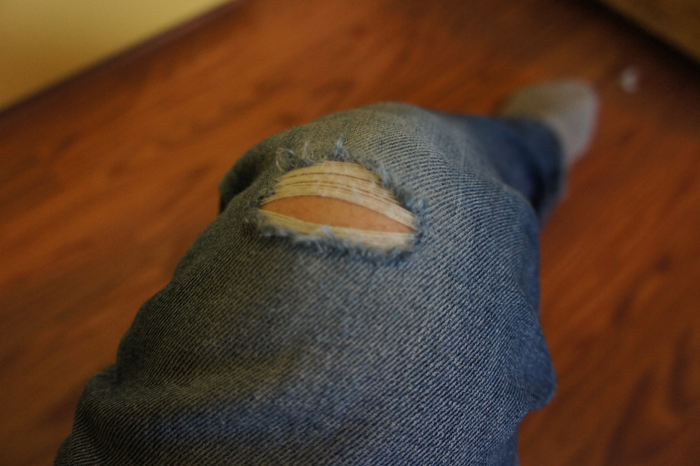
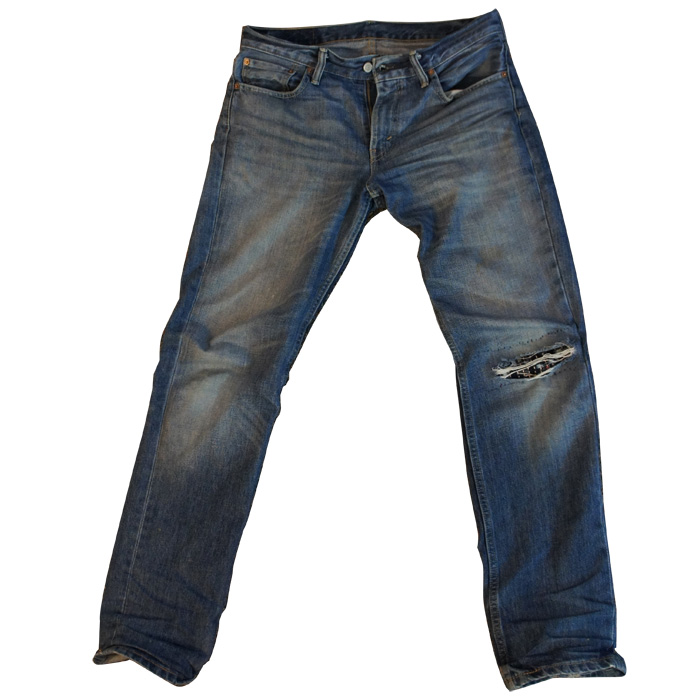
Surprisingly nice warm day in February of Pensylvania. I decided to do a small Sashiko mending project in a warm sunlight. What do you do when you find a hole in your jeans? I repair it with Sashiko stitching. Sashiko Mending Project, here it goes!
Sashiko Mending Process with pictures
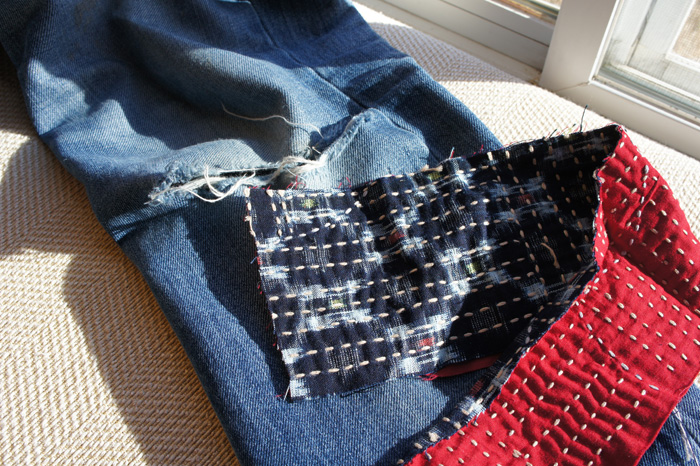
Match the Sashiko fabric to jeans. Ah… it is so bright and warm outside. I have been waiting for this warm day over severe winter in Central PA.
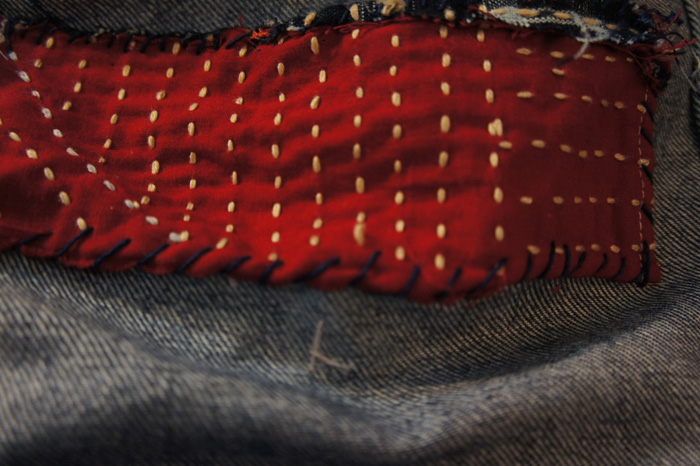
The Sashiko fabric in the photo is the leftover (the edge after trimming) from different Sashiko project by “Sashi.Co & Keiko Futatsuya.” Preparing and making the Sashiko fabric is the most enjoyable part of Sashiko… and picking the best matching fabric is the most exciting time. I choose this Japanese vintage fabric, layered with red vintage one.
Preparing and making the Sashiko fabric is the most enjoyable part of Sashiko… and picking the best matching fabric is the most exciting time. I choose this Japanese vintage fabric, layered with red vintage one.
The fabric has 2 layers. It looked a bit frayed on the edge.
Therefore, I used a sewing machine to trim the edge for easier repair.
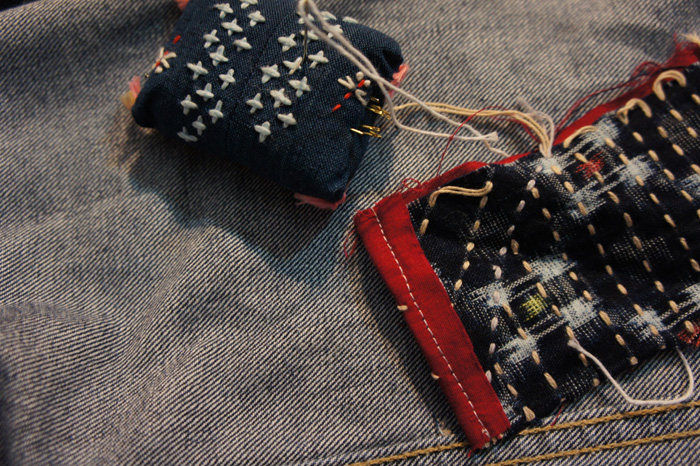
Next… Prepare the needle and thread.
Use any thread to do Basting. It will be removed after performing actual Sashiko.
No need to do it if the project is simple. I still need to do basting to get the better result… more practice.
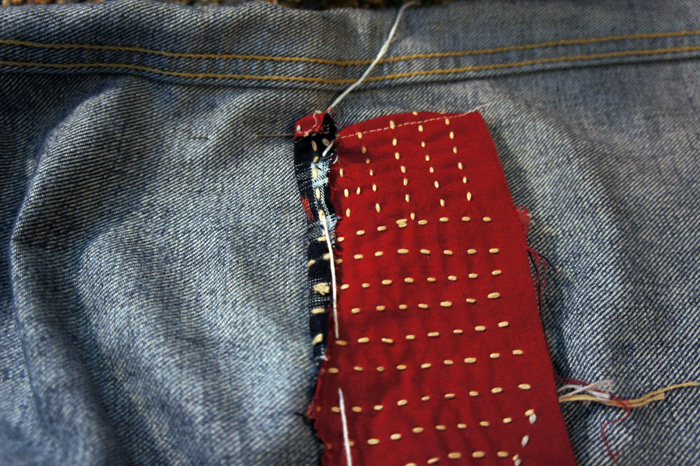
I used blind stitching technique here to attach the fabric to the jeans.
Yes, I am patching the fabric from the back so the jeans will have the main fabric from the hole. I also used the Natural Indigo Dyed Sashiko thread here. The better Sashiko thread I use, the better result I get. Don’t forget to use our Sashiko thread for the best purpose.
Sashiko Mended / Repaired Jeans is cool, I believe.
Done! I am pretty satisfied the result. It will get better by using this pair of jeans since the damage will make it more natural.
It took about 1 ~ 2 hours to complete the mending and repairing process, including the matching the fabric time and excluding the Sashiko fabric preparation. Again, It doesn’t include the time of preparing Sashiko fabric.
Upcycle it to get another value.
Sashiko is a process of repairing/reinforcing the fabric to repurpose. Upcycing the fabric is our daily mission.
I hope this small project will share some insight into the beauty of Sashiko and mending.
Let’s see if I can share the clarification of Sashiko Definition. In this page, I try to navigate you to understand what Sashiko is.
As a foreword of this serious of articles, I shared my conception and understanding of Sashiko first. It would be great to spare your time to read it through in order to avoid unnecessary misunderstanding. My goal is always simple. It is to share the joy of Sashiko. Therefore, our mission is pretty simple as well. It is to provide the good quality information to make Sashiko more public (open-source). I hope this page will provide some clarification.
Here is a serious of articles about a question of “What is Sashiko?”
“What is the difference between Sashiko Stitching and regular stitching?”
I often receive the question. It is difficult to exclusively distinguish what is Sashiko and what is Not sashiko, so let’s start the serious with my challenge of explaining the terminology and definition of Sashiko.
According to the Wikipedia
Sashiko is a form of decorative reinforcement stitching (functional embroidery) from Japan. Traditionally Sashiko was used to reinforce points of wear or to repair worn places or tears with patches. This running stitch technique is often used for purely decorative purposes in quilting and embroidery. The white cotton thread on the traditional indigo blue cloth gives sashiko its distinctive appearance, though decorative items sometimes use red thread. (https://en.wikipedia.org/wiki/Sashiko_stitching)
This description is quite accurate.
A few key phrases are;
It is a functional embroidery to strengthen the fabric.
It is a technique to repair, reinforce, and mend the worn places and tears on fabric.
Recently, it is used in quilting and embroidery for decorative purpose.
Technically speaking, as long as the products use the fabric based on this concept, we may call anything Sashiko. One thing I would add is that all stitching in Sashiko is hand-stitching. Although there is an option to use “Sashiko machine”, I personally do not want to call it Sashiko if it is done by machine. The beauty in perfection is another key in Sashiko culture.
In fact, if we follow the primitive concept of Sashiko to mend the damaged fabric, probably using sewing machine will destroy the fabric more by using strong needles and bobbins. It is a side note.
Sashiko as a process
Until 2014, I explained the Sashiko definition like I did above paragraph. Sashiko is a form of stitching, and I thought of the result: the result in form of fabric with Sashiko on.
Recently, however, I start realizing Sashiko is not only the result, stitched fabric, or stitching techniques, it is but also a process of mending the fabric.
A few hundred years ago, women repaired men’s jackets. When they stitch, they thought of men who work hard outside. They patched the fabric with hand-stitching. They tried to make it more beautiful with limited resources such as just indigo dyed fabric and white thread.
I believe this process is called Sashiko, not only the result with stitching.
In order to explain the deeper side of definition and process of Sashiko, I would need to share the history of Sashiko. Let’s do it next time.
As a Sashiko artisan, I would need to answer to a fundamental question; “What is Sashiko?”
The answer to this question would require a serious of explanations on its background. Yes, this website “Upcycle Stitches” has the exact mission to explain and share what Sashiko is. Before establishing the database of Sashiko history and culture, I would like to share my conception of Sashiko. For the series of articles to define what Sashiko is and for the answer to the question of “what is Sashiko ?” please visit our cornerstone page for Sashiko definition and terminology.
Keiko explaining about Sashiko in Otsuchi Sashiko Project
Sashiko is a Process, not a Result
Sashiko is a form of stitching.
The purpose of stitching originated from repairing, mending, patching and reinforcing the fabric. Also, in some regions, the Japanese performed Sashiko for the decorative purposes. In the current society, we enjoy Sashiko to decorate the fabric like embroidery. We also use Sashiko techniques to repair the damaged fabric to recycle (upcycle) and repurpose the fabric to something unique. We can see the Sashiko stitching in Fashion Industry Trend.
Katazome Vintage Fabric with Sashiko stitching to strengthen the fabric.Sashiko to repair the damaged Fabric on the Denim Jeans
There are various styles of Sashiko stitching. The Japanese developed Sashiko in many locations in Japan. Wherever a town (or a village) is surrounded by mountains and had a lot of snow over the winter, the place likely to have the Sashiko culture or similar stitching customs. In short, Sashiko is a culture developed in poverty and inconvenience because of poor logistics. The Japanese who originally performed Sashiko didn’t have enough fabric to make the new clothes.
We can see more than 100s of patterns in the Sashiko history. Sometimes, it doesn’t require the pattern to make beautiful Sashiko stitching, especially when they focus on mending and repairing the fabric. It is not productive to discuss what is Sashiko and what is NOT Sashiko based on the patterns and stitching techniques. However, to clarify the understanding of Sashiko a little bit more clearly, here is the list of aspects (elements) of what Sashiko is, and a list of what is NOT Sashiko.
Sashiko Elements
Hand-Stitched*
Appreciation to the fabric
Concept of Mottainai – too good to waste
The main purpose is repairing and/or decorating the fabric
Repetition of mending, repairing and using the fabric
*There is a Sashiko sewing Machine. Personally, I do not think it is Sashiko.
What is NOT Sashiko
Printed Pattern | Some says that the printed Japanese geometric patterns are Sashiko.
Decorative Embroidery (They are beautiful, but not Sashiko)
Products made from Sashiko Weave Fabric
*The list is based on Atsushi’s understanding. No intention to deny anybody’s understandings.
*Sashiko Weave Fabric is the sheet of textile woven imitate the Sashiko Stitching.
In the market, there are many products named Sashiko.
I am fine when the seller mentioned “Sashiko-Like” on the product description. However, when I see people using the word of “Sashiko” for only the marketing purpose, I feel pretty irritated. Sashiko isn’t about neither the Japanese geometric pattern nor the fabric similar to Sashiko hand stitching. It is about the hand-stitching with appreciating the fabric as well as the people who wear the fabric we stitch on.
Sashiko isn’t the result. There are Sashiko products made AFTER the Sashiko stitching, and we call it “Sashiko Jacket” or “Sashiko Bag.” However, Sashiko cannot be Sashiko without the process of appreciating the fabric and hand-stitching it. Therefore, my conclusion is that Sashiko is the process.
Sashiko is the process, not the product.
I hope we can share the fun process of Sashiko and the beautiful result of sashiko stitching.
*Well known Boro is the ultimate result of Sashiko.
Enjoy Sashiko | with thinking less of Right or Wrong
There are many tutorials in form of books, DIY kit, and online materials such as video and websites. You may have arrived this website by searching what is the correct way to do Sashiko.
I usually tell my students that there are no rules or restrictions in doing Sashiko. It is much more important the people continue enjoying stitching than giving up continuing because of its obstacles such as regulation and rules. In short, I believe there is no such a thing as “Right or Wrong” in Sashiko.
However, please do not misunderstand my words. I am not saying that the books and tutorials about in the market are “mistaken” because some of them explain the rule, like what to do and what not to do. In fact, I sincerely respect the contribution to this Japanese stitching culture from many people, in and out of Japan. I am happy that I am part of it to embrace this beautiful upcycle and repurposing culture.
I am not saying that the books and tutorials about in the market are “mistaken” because some of them explain the rule, like what to do and what not to do. In fact, I sincerely respect the contribution to this Japanese stitching culture from many people, in and out of Japan. I am happy that I am part of it to embrace this beautiful upcycle and repurposing culture.
Some rules. No restriction. Never Right or Wrong
What I try to share is the most efficient and enjoyable way to embrace Sashiko from my family’s experience. I will share some of the rules to make looks better. Many of books and online tutorials are sharing their perspective to make stitching more beautiful. It is up to you to decide what is beautiful or not. So, I want you to feel free to investigate as many techniques as possible to expand the experience.
There are some rules to make it better, but no restriction you have to follow. There shouldn’t be any “right” or “wrong” in Sashiko art. As long as the art has the purpose of “appreciating the fabric by repairing, stitching, and strengthing.”
Make it available (Open-Source) for people who wish to enjoy
One of my goal of establishing this website is to make Sashiko open source, available for anyone who would like to enjoy. The best way to learn from me is to join the workshops. However, I understand that not everyone can make a trip to wherever the workshops are available. Also, I would like people to have access to the information so they can continue enjoying Sashiko.
Please visit my tutorials to enjoy the technique and its culture.
What I am trying to do is simple. I want to share the joy of Sashiko to as many people as possible. I hope you can be part of the movement, to appreciate the fabric and make what we have to beautiful and wonderful art. Upcycle and Repurpose it.
I am still looking for the answer to “What is Sashiko?”
I am sorry that I didn’t provide the complete clarification of what Sashiko is. What I could provide was the pieces of information and my understanding toward Sashiko.
In summary, I wanted to share the fun of Sashiko by simply enjoying stitching instead of worrying what is Sashiko. At the same time, I understand that there is a need to define what Sashiko is, with perfect clear clarification.
I used to have the solid definition of Sashiko . However, after learning other types of Sashiko in Japan and learning their culture, I start doubting myself. It is a good thing to doubt and re-define what Sashiko is. I am still on a journey of looking for the answer to the question. “What is Sashiko.” You are now a member of this jouney. Thank you for reading the long article.
I hope I can reach to the definition with you, by enjoying the research on Sashiko and creating more Sashiko Pieces.
When I start introducing Sashiko in English about 10 years ago, the word of SASHIKO wasn’t popular among the general public. People in patchworking and quilting were eager to learn the Sashiko stitching techniques. I remember my challenges to try to reach out to quilting and patchworking enthusiastic people. Recently, I meet new people with the knowledge of Sashiko, and these people come across to Sashiko throughout mending. Sashiko Mending Jeans are especially popular among the new fashion.
People in patchworking and quilting were eager to learn the Sashiko stitching techniques. I remember my challenges to try to reach out to quilting and patchworking enthusiastic people.
Sashiko in Fashion Industry.
Recently, I meet new people with the knowledge of Sashiko, and these people come across to the word of SASHIKO throughout mending the fabric. Especially, Sashiko Mending Jeans seems to be popular, I assume. Interestingly, it is “Mending jeans with Sashiko” that I enjoy the most in Sashiko.
Sashiko Mending Jeans as a cool item
I was raised in the Sashiko family. Sashiko was always around me. However, I didn’t feel comfortable wearing most of Sashiko products in daily life simply because it wasn’t fashionable in the 21st century. As the side project of my regular Sashiko work, I started working on my garments like denim jeans, jacket, cotton shirts and so on. Then, I realize how cool Sashiko can be. It was around 2010 ~ 2011, then the time of realization how important it is to pass down Sashiko to the next generation comes to me after the earthquake in Northeast of Japan.
Sashiko is a process, not the result
Here are some photos of my jeans that I am working on mending, and wearing pretty much every day. Sashiko is not only the result. I start realizing the Sashiko is the process of mending, repairing, and reinforcing the fabric. Sashiko Mending Jeans will not be the end product since it requires repetitive patching and stitching. When I sell my Sashiko mending jeans, I would like to teach the buyer how to Sashiko it by himself/herself. Anyway, here is a serious of photos, as of today.
However, mending (sewing) means adding extra tension to the part of fabric without stitching. Therefore, the part without Sashiko thread starts getting torn. Then, I would need another mending project. This is why I say that Sashiko is the process, not the result. It is perfectly fine since it is fun doing it, and the more mending projects I would do, the Sashiko mending jeans get fashionable. (By the way, I believe “Boro” is the result of this repetitive mending with Sashiko. I am making Boro in future now!)
A hole. Thinking how to make Sashiko stitching on
I cover several methods of Sashiko mending in my workshop. It is a fun part for me to think what to do. I will update the result after I do Sashiko mending.
Preparing Sashiko fabric and matching it
Although I haven’t started actual mending process, I have prepared the Sashiko fabric to patch. Using Japanese vintage fabric with Natural Dye Sashiko thread, it will be a fantastic match.
I have a plan to make a serious of tutorial… wait for the update and keep stimulating me by leaving comments or messages so I will get motivated a lot faster.
In order to learn Sashiko stitching with our method, participating in our Sashiko workshop is the best & easiest way. In 3 hours + α long workshop, the Sashiko instructor (usually Atsushi) will share his technique and experience. Sashiko stitching workshop, the instructor will sit next to you and put the hand on your fingers to teach how to use the Sashiko thimble and needle, the posture and rhythm.
[Update | July 2018]
Learn from the expert. Learn the tradition.
Over 2 years of our workshop offering to more than 70 graduates, we have 100% satisfaction feedbacks so far. Our goal is not only teaching the Sashiko technique of “how to”, but also sharing how enjoyable Sashiko is in your life with the mindset behind it.
Enjoy Sashiko! It is our phrase.
Therefore, satisfaction in the Sashiko workshop is very important to us.
Sashiko Workshop Availability
Over time, we develop as many workshop styles as possible to introduce Sashiko. Please check our website for more information that match your needs.
Customized Sashiko Workshop (in PA or your place)
The sashiko instructor (I, Atsushi), lives in Lewisburg, the central Pensylvania.
I am happy to offer the Sashiko workshops if you could make a trip to the city of Lewisburg. The workshop is about 3 hours long. I am usually available on weekdays between 9 am to 4 pm. Also, I am available to travel to your place if the driving is in about one hour (or invite me overnight), with your responsibility of preparing the place for workshops and covering the travel expense. Since I do not have a specific day opened for workshops.
Here is a list of the details we need to confirm.
Participants of 3 are the minimum size of the workshop for the regular workshop price of $140.00 and up per participants (including all the workshop material). The maximum size is 8 participants. Please contact me if you would like to have a private workshop or have only 2 participants.
Travel expense is based on standard mileage calculation (0.54 USD per mile). If you invite me from Philadelphia, the cost of travel expense is about $150~$200, a round trip.
If you are an owner of a shop or a studio, thinking of hosting the Sashiko workshop, I am happy to share the term and condition to offer Sashiko workshop in your location.
For more information, I updated the blog post about having me to your place to offer the workshop.
Please check the detail of the workshop and hopefully find your ideal schedule. We just started offering it, but we did! Contact me if you have a request in scheduling the specific date.
There are numbers of requests to have online workshops. I understand that it is costly and troublesome to make a trip to NYC/Brooklyn and/or the central Pensylvania. My concern is whether I can provide the workshop with the same quality since participants satisfaction is very important for us.
However, I also understand the needs. If you are interested in taking our Sashiko Online Workshop, please leave the comments here, or simply contact me to tell me you are interested. When I have a good number of potential participants, I would like to develop the online workshop with the help of those potential participants.
I will continue Sashiko Workshop, thanks to you.
Our goal is to share the Sashiko technique and the mindset behind it. I sometimes say that I want to make Sashiko “open-sourced” information. I could use some financial aid to continue doing:
To encourage the both generation, the older generation to appreciate the technique they have, and the younger generation to inspire them.
Some people mentioned the cost (costly pricing) of our workshop. I hope the participants understand the price of our workshop, as well as the price we have the products and supplies. It is my biggest intention to pass Sashiko down to the next generation.