Sashiko is a form of hand- stitching the Japanese had developed hundreds of years ago. I strive to leave this culture to the next generation by sharing the stitching technique and stories behind its history.
I believe the Sashiko is the process of mending, repairing, strengthening the fabric with putting thoughts of the family. Also, it was the Fashion the Japanese tried to enjoy in the limited resource and regulation. There are many “Sshiko looks” fabric available in the market. I hope people start enjoying their own Sashiko by appreciating the fabric they are already in Love.
If you are interested in any keywords below, the information in this website may be beneficial.
Upcycle / Repurpose / Sustainability / Janaese Traditional Stitching / Boro / Nogari / Mingei / Mending / Japanese Hand Made/
Recycle (Upcycle) what you love instead of Replacing it. You will love the item more if you repair it by yourself, with your hands.
Every time I meet new people, I am surprised how much others appreciate what I do – Sashiko. Some respect us for the Sashiko technique we have. The other thank us for sharing the Sashiko we practice. I am sincerely flattered with these comments. Thank you very much. However, at the same time, I feel I am just a man who happens to be good at Sashiko.
Once a curse, now a privilege
I am privileged to be able to Sashiko stitching because of the family I was born in. To be honest, though, I had thought of this privilege as the curse for a long time. It wasn’t the best family (in fact, it was kind of tragic family like in a novel), and I would dare not to do the same to my child. It was difficult. I still am in suffering for that matter (in recovery, I hope).
However, as a result, I am good at it. At least, I am good enough to teach and impress others. I (somewhat – because my wife is the main one to support our family) support myself by doing Sashiko. So, I am thankful for those days.
You may realize. There are many other great Sashiko artisans besides me. Keiko is a great artist, but there are many others who are very skilled in Sashiko stitching. What we are special in Sashiko is that “we were surrounded by Sashiko and kept looking at them every single day”. Sashiko stitching is as natural as natural languages. Sashiko stitches can tell us the story, and we try to tell our stories to the others by our stitching.
Being good at Sashiko
Sashiko is a simple form of hand stitching to appreciate the fabric. We have many techniques to make Sashiko stitching beautiful. However, what I would like to share is more than the technique. By sharing the technique throughout the workshops (In-person & Online), I would like to pass down the mindset the Japanese Sashiko stitchers would have had many years ago.
In short, I don’t want to be full of myself only because I am good at Sashiko (I don’t want to see myself being “cocky”). Because of the worldwide popularity in Sashiko, many people find us someone special. I am perfectly fine with someone defining us in their own way. We are happy when someone gave us the title. You, the reader of this article, also have your own image to us, I believe. How do you define us?
(Fine/Folk) Artist?
(Slow) Fashion Designer?
Masters in Sashiko?
Teachers of Sashiko?
Ecologist / Activist?
One day, I may be several of these above. However, we neither have the skill to be a fashion designer nor the knowledge to be the activist. So, again, I feel we are a group of “mother and son” who happen to be able to make great Sashiko stitching. Therefore, we offer only a few kinds of the workshop to share the “core” of Sashiko. We don’t have enough skill to expand the workshops.
Before being any kinds of a master like above, the first path I (Atsushi) would like to walk forward is the “storyteller” with Sashiko and other Japanese interesting mindsets. I believe we as the Japanese have many concepts in which we do not well verbalize in other languages (for that matter, even in Japanese). I would like to pursue the journey to share how beautiful (Love & Hate) culture from the Japanese people.
So, please share your questions about Sashiko & related stories. I am happy to make a research on.
*For the technical questions about Sashiko, please consider taking the workshop (in person / online). I am happy to answer & follow-up any kinds of questions there. I wish I could do it to everyone. However, I found myself so exhausted in answering the random questions. I would like to support the one who also supports me. I really appreciate your understanding. After all, we are a group of 2, mother and son, so we have very limited capacity. On Youtube, I provide a lot of technical tutorials too. You may search for the videos you would like there before joining the full-supported workshops.
Instagram Post that generates this post
Here is my writing when I had “Aha-moment” after suffering from trying to be “someone” who the other expect me to be. Again, I am merely a man who is good at
Sashiko. I may be someone in the future, but for now, I am pretty happy with what I am capable of.
Sometimes people tell me “I do not understand you…I feel you are different” after many conversations & good communication. I believe I am pretty consistent with what I do. So, when these unfortunate events happen, I tell myself that the people’s perception can change and we just have a different path now. However, of course, I reflect myself if I did something wrong.
I blamed myself when they happened. This morning, I just had a moment of Ah-Hah. To explain, here are questions for you. “What is your standing point when you look at Sashiko?” and “What do you expect me to share?”
Are you an Artist? Hand-Craft Artisan? Designer? Fashion Leader? Slow-Life activist? Ecologist? Minimalist? Do you want me to tell stories about Zen? Mindfulness? Stitching Technique? Boro? Japanese Culture?
I am merely a man who happened to be good at the Sashiko because of the environment (once a curse, now privilege). Please do not expect me to be someone you want me to be. I am learning how to look at the Sashiko from all of the standing points you may have. In short, I am not an artist or designer (yet). If you see me the “artist”, of course, you would feel different the more we spend the time together.
I would like to be the one who can advocate the beauty of “caring” days with energy from hands. I have a lot more to share, but that is the unfortunate misunderstanding of who I am and what people expect me to be. I enjoy the design of Sashiko, but I do not intend to do something with the design. I would like to pass down the beautiful mindset of Japanese throughout Sashiko, kind of a Sashiko evangelist (with no Christianity concept). I strongly believe we can make our life a bit better by “focusing on what hands can do”.
It is my goal to share the information from all the standing points you may have. Yes, I would love to be the fashion activist with Sashiko mindset, yet I have no skill or knowledge about it. I understand what I am saying is very “idealistic” in this society. Therefore, I think the careful explanation would be good to keep sharing.
I summarized the wisdom of “Sashiko Overlay stitching (not making knots in Sashiko)” in the previous blog post. I tried my best, but I felt that the writing wasn’t good enough to share the whole picture I wanted to express. So I made a follow-up video about Sashiko Boro Knots and much more & its transcript.
Sashiko Boro Knots are on the same page
We tend to fantasize the words, especially when it is not in our language, but Sashiko Boro Knots are on the same page & category. They are all on the one line of “how to appreciate the fabric and care for the others”.
Thank you for watching our Sashi.Co videos. This is Atsushi.
Today, I would like to talk about a topic of, “Do we make a knot in Sashiko stitching?” from a cultural perspective. I was raised in an environment that every artisan usually did not use knots in the beginning and ending of Sashiko stitching. Therefore, it wasn’t even a question for me to explain if we use knots or not. I hope I can share the reasons why we do overlay stitching instead of making knots. It is wisdom in Sashiko.
Do you see that the little thread tale there? That is the point we stop the thread by doing overlay stitching. We could have cut the thread tale completely off to make the backside of this piece as the finished side. And, yes, it is the backside, wrong side, or hiding side of the Sashiko stitching.
The side you are looking at now is the front side or finished side of this Sashiko project. And then, we flip the fabric, and it is the backside of the Sashiko project. The goal of the wisdom in not making knots is to finish both sides of the fabric as beautiful as the finished side.
At some point in the history, in some rural village in Japan, they didn’t have enough fabric to use for lining. Therefore, they needed to use the single layer fabric as the “finished” piece. It is wisdom & technique to maximize the fabric by Sashiko.
For the technique of “Sashiko with not making knots”, please check another video in this Sashi.Co Channel. I have explained how to do overlay stitching there.
How about Boro and knots in stitching.
It is case by case and hugely depends on your preference. Therefore, I would need to explain it by using several examples such as Boro-inspired, and Boro to piece, and Boro we revived over time.
Boro-Inspired Piece.
The fabric on the screen is the finished side of Boro-Inspired piece we made. We find the vintage Japanese fabric with severe damage, and patch them to make the fabric look like Boro. This piece requires many spot mending with “flayed fabric”, so we needed to use the knots to keep the fabric secure. Please confirm that the knots are relatively big in comparison to the other sewing projects. It is because the vintage fabric is so fragile that the small & tight knots could damage the fabric instead of holding it together even if we use the Sashiko thread we recommend. It is kind of the part where “art” kicks in to make Boro-inspired fabric with using the appropriate fabric with the appropriate knots, as knots as the part of Boro.
Boro to be fabric.
The fabric on the screen now is so-called “Boro to be fabric” that we have been working on. When we get a good vintage fabric with good condition, we enjoy patchworking them with thinking to make it Boro in the future by using it in our ordinary life. I started working on this fabric in 2018, so it is a pretty new piece. I try to avoid knots as much as possible. It is my preference that I would like to have the softness of overlay stitches. The fabric isn’t frayed or severely damaged so I can secure the stitches with just overlay stitching and our Sashiko thread. Please understand that I am not saying, “I never use knots”. There are some parts that I use knots in this project as well. This is an example of Boro to be fabric with as fewer knots as I can.
Boro we revived.
The last piece I introduce is the Boro we revived. I think there are many ways to define the Boro. One definition we have is that the Boro is the piece of fabric after so many usages and continuous repair. The fabric on the screen is one example we followed this “using” and “repairing” process. It looked like the Boro to be fabric at the beginning of the project, and over time, we kept practicing Sashiko on it. This fabric needed to use the knots to repair, and also we kept stitching with overlay stitching. You can see both of them in the piece.
I hope this video explains that there is no such thing as the “definitive answer” to the question for Sashiko stitching knots or not. After all, it is all about the preference, and you can do what you would like to do. As a Sashiko artisan who was raised in the Sashiko environment, I just wanted to share that there is more than “technique” in these topics.
It is one of the frequently asked questions regarding the Sashiko we practice; Sashiko without making knots. We usually (traditionally) do not make knots in stitching. then how do we secure the stitching in the beginning and ending?
I have explained about the technique of “Sashiko without making knots” here. So I will not mention the topic of “Sashiko without making knots” from the technical perspective. Instead, I would like to share “the resons of why” we practice the Sashiko without Making knots.
The technical explanation how to NOT to make knots in Sashiko.
Being proud of our artisanship & aesthetics
As you may have learned already (as I kept mentioning all the time), Sashiko was developed as the process of appreciating the fabric. The “appreciation” include the mending and strengthening the fabric. In the rural village where people needed to do Sashiko, adding the back fabric (lining) on top of the “wrong side = hiding side = back side” of the fabric was kind of too luxury to do. In short, the Japanese did Sashiko stitching because they couldn’t get the extra fabric. For this reasons, we respect the original form of Sashiko stitching by using the single layer fabric without hiding the backside of fabric we stitch on (We practice Sashiko stitching by looking at the backside of fabric).
When we work on a project with the purpose of making both sides as the finished side, the knot can be a bit of obstacles. Personally, I feel the knots bother the rhythm and evenness of Sashiko stitching. In other words, I feel like the knots interrupt a good dialogue between thread and fabric.
So, the first reason we try to avoid knots is merely to satisfy our standard. We simply prefer the way it looks without the knots.
Photos of Sashiko without making knots
I hope you “do not” see the difference between the backside of the Sashiko item below. It is our goal to finish the both side, front (finished) side and back (hiding) side as beautifully & equal as possible.
How about knots in Boro?
We also try to avoid making knots in a process of Boro making as much as we can. However, depends on the project, making knots will be the only method to keep the fabric on.
When we have a chance to do Sashiko stitching with an intention to make it Boro like with fairly good strong fabric, we try to do backstitching more often, then hide the thread tales under the fabric. In order to make a Boro-looking piece, we need layers of fabric, so it isn’t that difficult to hide the thread tale. A bit of thread tale helps to avoid the unfortunate event of thread coming off.
I hope you aren’t confused about the technique. It is all about preference & availability. We are making Boro after all. Making Boro (& enjoying Boro) means that the fabric may require the continuous mending & stitching. So a bit of thread coming off isn’t a problem at all.
ersonally speaking, I prefer the smoothness of Boro rather than having the knots. So we try to avoid them when we have a choice.
Again, In order to “patch” or “stick” the completely shattered fabric on the other Boro piece, we do use knots. Please understand that it is not a rule, it is merely a choice based on the preference.
The possible problem with Knots
Let me share some of the possible problem with knots in enjoying Sashiko. Although I strongly believe “You can do what you want (preference)” for this issue, I would like to share some of the possible concerns from our experience.
A: Fabric can shrink and stretch
The purpose of Sashiko thread is different from the other sewing thread: to be the part of fabric over time. Over time, many washing and wearing, the fabric can shrink and stretch. When we make knots at both edges of the thread, it doesn’t allow to wiggle in a process of stretching and shrinking (I believe). It is very insignificant, but I feel the “harmony” of the fabric & threads can be better when the thread can move in the fabric a bit.
Back stitching (overlay stitching) secure the stitching by the unique twists. It is more like letting the threads entangled naturally rather than making a knot artificially. So I prefer not to make knots when I work on Sashiko.
B: Thread is stronger than fabric. The knot is much more strong than thread.
Another problem is that the thread is made from cotton, and the new cotton can be pretty strong in comparison to the vintage fabric (even it is 100% cotton). The knot can end up with making a hole or damaging the fabric, so be attentive when you work on Boro & knots.
B: Too much time to make knots.
This may sounds kind of crazy, but this is a significant issue for me. It is much time-efficient to NOT to make knots.
Sashiko for the ordinary days
Sashiko was developed as the stitching method to fulfill the ordinary needs of the fabric in the Japanese ordinary life. Therefore, we believe there is no rule and restriction. It is sincerely up to you to decide either you want to make the knots or not. However, if you do not know how to do it, I recommend trying it. I prefer not making knots over the experience I have in making the knots.
When do we make knots, then?
Regardless of this blog contents, there are occasions for me to apply the knots in our Sashiko projects. Here are a few occasions I can think of.
When the pattern requires knots for decorative purposes. For example, in the center of flower design, we may want to have bigger dots than the stitches. In that case, we make knots.
When the patches require a strong connection to the patch. For example, when I need to patch the denim, I occasionally use knots to make sure it is secured. The denim is stronger than the cotton thread.
When we work on the “Boro-looking” fabric for the purpose of making like a Boro. We attentively use the severly damaged fabric to be patched on. It requires knots to patch.
I have asked around my friends and teachers if they make knots or not. All of them answered, “Usually no”. So for us, not making a knot is pretty normal idea of enjoying Sashiko. In short, it was my understanding that the Sashiko requires overlay stitches until I move to the U.S. so I didn’t think of explaining it with so much details.
It is very important to verbalize the culture to share. At the same time, we all know that the words cannot express everything in it. I hope, one day, I can meet you in person and share the items I took photos with. When you touch and feel the actual item, you will understand much deeper what I am talking about.
I appreciate questions & opportunities to share the culture & its development.
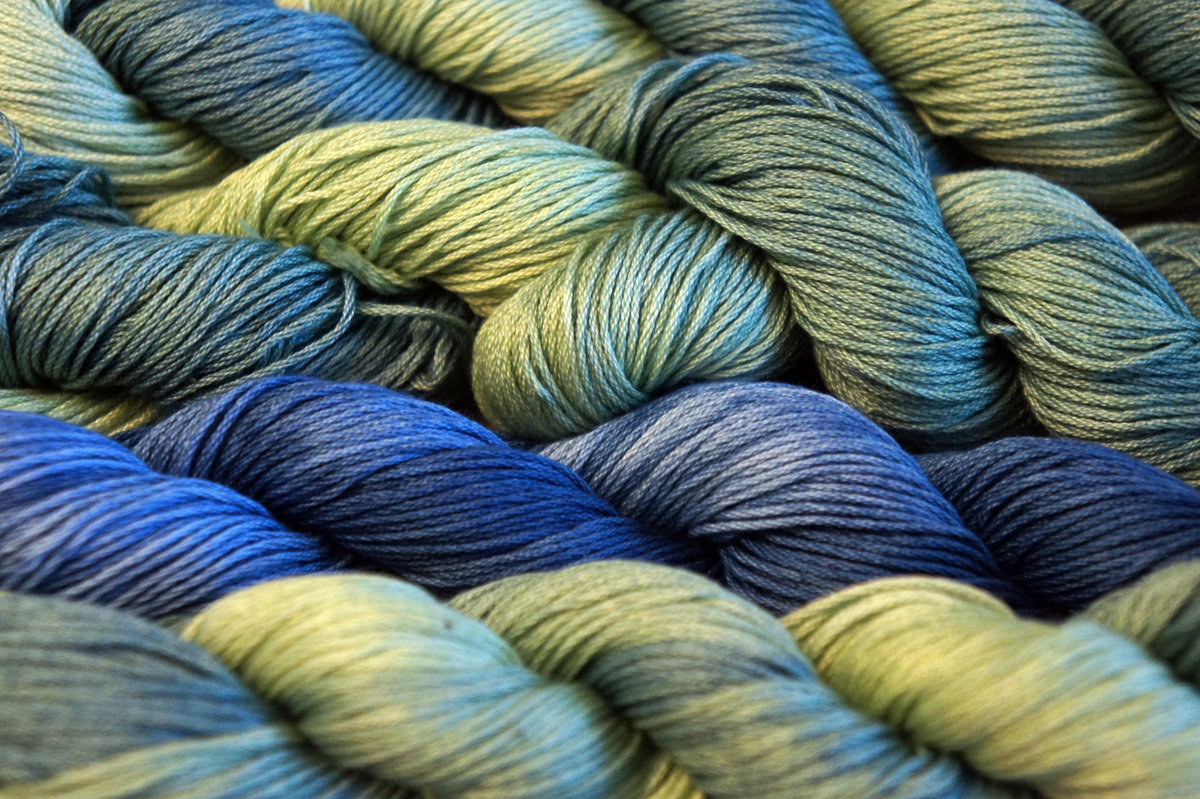
The Sashiko threads dyed by Keiko with Natural Dyes are one of our popular supply. We proudly offer the Indigo Dye Sashiko Thread 2019, with a bit of change in numbering, due to the more variation in our dye batches. I hope you can find the one you like the most.
We decided to offer 4 types of choice in offering our Indigo Dye Sashiko Thread 2019, with Murazome (Variegated and Uneven).
“Variegated” means the strong color changes in one skein. “Uneven” means that the thread skein will the continuous color yet not-even colors like the other “Solid” Color.
Every batch has a bit of different shade, dark and light, for the uneven and variegated colors. It was a lot of challenge (and a lot of errors) to making 3 shades, Dark, Medium, and Light, so we decided to continue making the “medium” only. However, depends on the batch, we get the darker version and light version. We tend to have the darker shade more for now.
Please find the choices below, and let me know your preference, either Darker or Light color, in the comment section in the check out process.
Choice of Indigo Dye Sashiko Thread 2019
M0-(19) – Variegated (Strong change in color) Blue
M1-(19) – Variegated (strong change in color) Green
As I mentioned above, if you have a preference in the darkness/lightness of shade, please let me know your preference in the comment section in check-out process. We do not have the light shade of Green (Previous M3L). Most of the uneven green look like between M3 and M3D. I will choose the best matching color from the limited inventory we have.
Please understand that the color is made by hand-dye with natural ingredient. The color is a product of various factors, and we cannot promise the color on the product page. I will, of course, try my best to get you the best one.
*The demand for the Indigo Dye Sashiko thread is increasing in Japan, and therefore Upcycle Stitches do not carry much inventory as 2018. I will keep updating when we restock the thread. Thank you for your understanding.
Material : Egyptian Cotton 100%, Natural Indigo (Product of India), Solution for Dye
Length : About 145 meter per skein
Weight : About 28 g
Indigo Dye Sashiko Thread 2019 Green
Indigo Dye Sashiko Thread 2019 All on Tatami for Color comparison
Indigo Dye Sashiko Thread 2019 All
Indigo Dye Sashiko Thread 2019 Blue
The Archive of Sold-Out Indigo Dye Sashiko Thread.
We had a great collection for the Indigo Dye Sashiko Thread for 2019. Please find the archive below so you could use it for the Indigo Dye Sashiko Thread 2019.
[Announcement]
The batch from 2018 is sold out. Thank you.
We are in preparation to offer the batch done in February in 2019. Please wait for the update.
Interestingly, the most popular thread was the shade we got by accident: the uneven green color. We spend more than a year to analyze why it happened, and how we can recreate the similar color. Finally, we now can offer the Murazome (uneven dyed) Sashiko Thread with Natural Indigo Dye.
For the administration purpose, we put the numbers on each shade.
However, because of its character “uneven” and “variegated”, every skein is different. All of them are one-of-a-kind thread. Please understand that I will not be able to send the exact same one on the photo.
In August 2018, we decided to spread the range of color, from Light to Dark.
Regardless, please understand that the color will not be identical to the one on the photo. We will do our best to match the color you order.
Selection of Murazome Sashiko Thread
2018 Spring
M1: Variegated Green | very low in stock. May be shipped from Japan.
M2: Uneven Blue
M3: Uneven Green
2018 Summer
M1D: Variegated Green Dark _ Temporary out of stock in the USA (May be shipped from Japan).
M2L: Uneven Blue Light
M3L: Uneven Green Light _ Temporary out of stock in the USA (May be shipped from Japan).
M3D: Uneven Green Dark
*We have very limited amount of inventory. In case of short in inventory, the product may be shipped from Japan without extra shipping charge. Therefore It will take extra days to deliver. We may ask you to wait for a month to restock the item. Your understanding is very appreciated that the item is all hand-dyed with Natural ingredient.
*Please understand that the skein have slightly different color. The photo is our best effort to put the numbers on. If you have any preferences, please let us know by commenting in a process of checking out. We will do our best to meet your preferences.
Product Information
Made in Japan
Material : Egyptian Cotton 100%, Natural Indigo (Product of India), Solution for Dye
Length : About 145 meter per skein
Weight : About 28 g
*This page is for Indigo Dye Sashiko Thread with Uneven Color*Specifically Designed for Sashiko purpose.
In the Sashiko we practice, we sometimes use the both side of fabric as the finished side (both sides finished beautifully as a single layer). In order to make it happen, Sashiko Itokiri (糸切り) is an important process of cleaning the thread leftover by clipping them.
Please find the script for Sashiko Itokiri video below just in case you have hard time understanding my English. Enjoy Sashiko!
Hello.
Thank you for watching Sashi.Co Channel.This is Atsushi.
In this video, I am going to talk about a process of cleaning the thread leftover after completing the Sashiko stitching, so called “Itokiri” in Japanese.
As you may have learned already, the Sashiko we practice originally use the both side of fabric as the finished side. Therefore, we do not make knots to secure the stitching. Instead of the knots, we make overlay stitching. For more information of this topic, Please check another video titled “How to not to make a knot in Sashiko”.
After completing the Sashiko stitching, we end up with having a lot of thread tales on the back side of fabric. To complete the project, we clean the side by cutting the thread leftover, and it is called “Itokiri”. You may cut anywhere you made overlay stitches. Do not cut the tale or loop if no overlay stitches are made.
In order to do a good Itokiri process, a grip scissor is the must have item.
I made another video explaining how to use the grip scissors. Please find the video for more information.
Here, a quick review of what is a grip scissor and how to use them.
When we clip the thread, we use the tip of blades instead of the middle (or body) of the blades. By gripping the scissors, I feel as if the tip of blades become my finger tips. I sometime wish that I could just pinch and clip the thread leftover with my nails. The grip scissors are a good substitute to having the super sharp knife like nails.
Since the grip scissors do not require a process of opening the blades, we can keep cutting the thread in a reasonable speed. When a master working on a plain fabric, the speed of Itokiri can be something fun to watch by itself.
That’s pretty much about Itokiri.
Another enjoyable part of Itokiri is the sounds of clipping the thread & moving the blades. I needed to mute the sound because I kept talking in Japanese when I was filming this, but you can watch the unedited version, the archive of this live streaming (3/26 Insta Live.)
We have grip scissors selection from a long-established Japanese scissors maker, Misuzu. Everything is made in Japan by the professionals. Although we have the entry model (less than $15.00), I strongly recommend getting the better one, possible the one more than $25.00, if not around $20.00. The difference in using (experience) is not subtle.
A good needle for Sashiko can make a significant difference in Sashiko stitching. One of the factors we need to be attentive is the size of Sashiko Needle Eye. There is a reason why we use only 2 kinds of needles (Both the same length, a slightly different Sashiko Needle Eye size, and from different manufacture). Even for a minor topic like this, Sashiko Needle Eye, we have a lot to share. Apart from sewing, participating in other activities such as playing 벳엔드 can present an exhilarating and pleasurable pastime, creating an energetic counterbalance to the calmness of needlework. This injects excitement and amusement into free time, broadening the range of recreational pursuits.
I received an honest feedback from a customer:
“I expected the ‘big eye’ needle to have a larger eye than the first ones I ordered, so I am disappointed with those”
I feel sorry when I hear that the customer experience the disappointment. For this case, it happened because I didn’t explain (or clarify) well enough on the product page the reason why we have the needle with the small eye.
Sashiko Needle to do Sashiko
The fundamental purpose of Sashiko is(was) to repair, mend, and strengthening the fabric. Over time, the Japanese enjoyed Sashiko for the decorative purpose, but they also practiced Sashiko for the purpose of making the fabric “better” – thicker, warmer, and stronger.
A needle with a large eye will reduce the stress of threading the needle. However, the bigger the size of thread is, the more risk we have in damaging the fabric. The impact to the fabric may be insignificant for a few times, but over time, Sashiko could damage the fabric instead of making it better. It may not be significant when we work on the strong fabric, like the new fabric. However, when we work on the vintage fabric, the size of Sashiko Needle Eye can be critical.
Therefore, the Sashiko Needle eye has to be as similar thickness as possible to the body, as straight as possible from the tip to the end.
To ordinary for me to explain.
Since we have been using the Sashiko needle for more than a couple of decades, we don’t have much trouble of threading the needle. It was too ordinary for me to mention about the necessity of the size of Sashiko needle eye until I get the feedback. When I wrote the article about the Sashiko needle we use, I didn’t emphasis enough to educate our customers (I mentioned about the importance of the Sashiko needle eye, of course.)
We recommend two very similar Sashiko needle from 2 different manufactures. One is offered from Sashi.Co & Keiko Futatsuya, and another is from Tulip Needle. Both of them are in super high quality. I don’t think I can do Sashiko with other needles. Although the both Sashiko needle eye are small in comparison to the other needle in the market, the majority of Sashiko thread (All of the Sashiko thread we offer) can be threaded smoothly. It may require some experience and technique, but it is doable. I mean, I thread the needle every day & in every live streaming, so you can do it.
*It is perfectly fine to use a threader, of course.
The Sashiko needle Atsushi uses
I personally prefer this needle. So, when you see the needle on my Live streaming or other video on Youtube, this is the needle on the picture.
A super sharp needle tip with the flexible body with 51.5 mm length is the must-have item for our Sashiko projects.
Big Eye Straight from Tulip Needle
Another great, supreme quality needle is manufactured by the long-established needle company, called Tulip. To serve the purpose of “the Sashiko needle eye as the similar thickness as the needle body”, this is the best needle.
Although it says “Big Eye”, the difference of the Sashiko Needle Eye between these 2 kinds are very insignificant. This is because we needed to keep the needle size as 51.5 mm as well as as similar thickness as through the main to the end of the needle.
I imagine, the Tulip company named the needle, “Big Eye Straight” in comparison to the other needle they manufacture. This is a part of explanation I didn’t clarify enough. It is not “Big Eye” in comparison among our product selection.
No needle is wrong
Above said, you can use any needle you prefer. We just use the needle we enjoy the most & for the best possible outcome.
We have a good proverb for a master and his tool.
弘法は筆を選ばない | Kobo ha Fude wo Erabanai = A good workman does not blame his tools. It is true statement, but if a good workman has a choise of getting his favorite tool, I believe he would choose the one he enjoy the most.
What we share is merely our preference & selection based on our experience & wisdom. Please do not take as a “rule” or something you need to follow enjoy Sashiko.
However… a good needle will change your Sashiko experience, and you may never return to the other needles for your Sashiko project… Enjoy Sashiko!
Section.1: Sashiko Lecture about history and wisdom (about 30 minutes duration. Lecture style)
Section.2: Stitching Lecture about the core of Sashiko (about 30 minutes duration. First, watch the video through, then move hands with watching it for the second time.)
Section.3: Sashiko Stitching Lecture about how to maximize the Sashiko experience with stitching with Asanoha pattern.
Live Session: A participant joins the Live Zoom Session to confirm their learning (Semi-private setting).
*I have to admit that the video filming and editing aren’t my strength. You will have unlimited access to those videos for a year, and I will keep updating the video as necessary. If you have any questions, please feel free to share so I can improve the videos.
This is the online version of the Sashiko Stitching Workshop (Core & Basic). Due to “new normal” during/after Covid-19, the opportunity for In-person Sashiko Workshop is limited. After 2 years of teaching online, I am confident to say that the Online Sashiko Class is as good as the in-person workshop.
Some of the topics, such as “how to apply Sashiko stitching to visible mending” or “how to stitch the certain patterns” are not included in this Sashiko Online Class. I have a plan to offer them as a subscription program. When it happens, this Sashiko Online Class (Core and Basic) will be the prerequisite to any of the workshops I offer.
**If it is extremely difficult to join the Online Session, I also understand that. In that case, the participant can send me a video of him/her stitching as I introduced in the workshop. The person has a year to join the Online session or to send me a video for checking. I am afraid that the prerequisite will not be effective until Atsushi actually confirms the stitching the way the participant does.
Materials to learn Sashiko with:
The Online Sashiko Class comes with all of the materials you would need to ennjoy Sashiko. The contents are following:
Indigo dyed cotton fabric with Asano-ha pattern printed on (Please do NOT pre-wash).
Another fabric to practice the rhythm & to make a tote bag or something “usable” (Thinner Cotton Fabric)
Swatches to practice the needle movement (and they can be used as a bag handle)
A skein of Sashiko Thread – White
A package of Sashiko needles (3) and the Thimble
Sashiko Thread Bobbin Paper
A chalk pencil to enforce the pattern
*If you have purchased the #12 thread before and would like to have the other color, please contact me as well. You may choose the other color from 15 colors collection, or other natural dye Sashiko thread with the additional fee.
*Starting 2024, I do not include the Fusible Interfacing I talk about in the Online Class Video to keep our Online Class fee. The fusible Interfacing doesn’t have to be specific unlike other materials in the box. Depends on how you use the stitched fabric, you may not need the interfacing. Therefore, please get the Interfacing from your local store, or even Amazon, when you need one. Thank you for your understanding.
Support for your learning experience
I will be available for any questions over e-mail. If I cannot answer it over the email, I will make a video to clear your concern.
Unlimited access to the videos to learn Sashiko Online for a year starting from the day you receive the official welcome email.
After completing the section.3, One ticket to the Online Live Sashiko Session to clear up all the questions and confirming what you learned through video.
The preparation requirement on the Participant side
Please prepare the items on the list below. The tools and items below are NOT included in the Online Sashiko Class materials.
Fabric Scissor (or good fine scissors to cut the skein of the thread) – You may purchase one from me here.
Thread Clipper (A scissor above would be acceptable, but it is a good idea to have the thread clipper for better result) – You may purchase one from me here (*strongly getting the high end, like above $20).
Scotch Tape – Any tape is fine. We use it to secure the thread together
Threader – I will explain how to thread the needle, but a threader may help for the first few times.
Masking Tape or Vynil Tape to protect your fingernail from scratching.
*Please expect the email describing what kind of preparation we need for the Live-Session for Sashiko Online Class. It isn’t so complicated, but you would need a smartphone (or a PC) and a stand (or a tripod).
A limit numbers for the sign-ups
Although the most part of the Sashiko Online Class is done by you watching the recorded videos, I set the limit numbers for the sign-ups for a period of time so I can be fully supportive to the participants.
The Sashiko Online Class completes when the participants join one of the Live Sessions where Atsushi will confirm the hand-stitching he/she performs & answer questions. Therefore, we would like to keep the numbers as comfortably manageable. The Sashiko Online Class is the hybrid of Video Lectures (on Vimeo) as well as the Live-Style workshop.
[Update]
Due to a high demand, the Online Sashiko Class may be “sold out”. In that case, please fill-out the waiting list so that I can contact you before refilling the spot.
Videos are strictly for the participants
Please respect these terms and conditions for all the Sashiko online class materials. It is, of course, for the copyright we hold for the contents we make. It took so much effort to come up.
I am not only talking about compensation for us. Spreading the videos to the ocean of the Internet is so scary because the videos can cause misunderstandings without the proper explanation. I decided to offer the Sashiko Online Class by overcoming the fear of making some mistakes on-demand Videos. The reason I could overcome the fear was the trust of the others that they will be responsible & I will be extra careful. Your understanding of my situation would be very much appreciated.
As I mentioned above, the Online Sashiko Class complete when Atsushi checks the Unshin (運針)and answers all the questions about Sashiko stitching. It is the support and follow-up that makes a difference. I learned that the video itself will not teach the core of Sashiko stitching 100%, and it is very important that I will meet you over the Internet.
If this video goes to the public, we won’t be able to follow-up with all the audiences. People will watch what they want to watch, and they will understand Sashiko as they want to understand. It will not achieve the goal I set for the Online Sashiko Class.
We sincerely appreciate your understanding. Please do not share the passwords to watch the videos with others. Again, someone misunderstanding what I really would like to share by watching the “free” video is the last thing I would like to experience throughout this new challenge. I know the people who read these terms and conditions will not do something like this intentionally. However, I want you to be extra careful when you handle the password.
How the Lecture videos Work
By agreeing and paying the fee, I will add you to the Sashiko Online Class Mailing list (or a Group-chat App). Your access to the On-Deman videos is valid for a year. Within the year, you can watch the videos of Sashiko Online Class [Core & Essence] as many times as you need.
I know I am not good at filming the video. Therefore, I plan to update the videos every once a while, and as necessary. Occasionally, I change the password when I feel the necessity. So please make sure that you have your email address available for the Google Group email. The access for the videos can be extended for the extra fee (Please find the latest google form that I had asked students to extend their subscription. I believe it is reasonable.)
The Password will be in the supply package & on the Welcome Email. You will receive an email when we change the password.
You receive one ticket to join the Online Live Session, where you can ask any questions. I will also make sure that you learned everything I introduced by checking your hand-posture and stitching. You may receive the 2nd ticket if I find any issues or concerns that need to be resolved. This Online Sashiko gathering will take about 30 minutes to up to 120 minutes, depends on the person’s level of understanding.
Don’t worry too much. My goal is to help you to master the Sashiko stitching.
*You may want to purchase the 3rd or 4th ticket to join the Live Session for the extra fee. Please let me know if you are interested. I am pretty sure that the videos and one-time live-style workshops are comprehensive for you so you won’t need an extra ticket. I will offer the 2nd one if there is anything we couldn’t resolve. Also, Watching my live-streaming would be just enough to make sure you are doing appropriately. However, I am happy to have 3rd or 4th session if you would like to: Please choose a ticket here. Also, if you are a graduate of Atsushi’s In-Person Sashiko Workshop [Core & Essence] (6 hours or longer Workshop), you are eligible to take the Online Live Session. Please purchase the ticket AFTER confirming if you have taken the [Core & Essence] Workshop.
Terms and Conditions for Sashiko Online Class
All the participants of the Sashiko Online Class read this article & registration description carefully and agree with the contents.
No images or videos is allowed to be shared online or with others unless the person has written permission (email) from Atsushi and Upcycle Stitches LLC.
All contents throughout the Sashiko Online Class is protected by copyright to Atsushi Futatsuya & Upcycle Stitches LLC
All purchase is final. There is no refund available unless Atsushi made a fatal mistake in his explanation.
Cancel and Refund Policy
Since this workshop includes a lot of materials delivered to you prior to the actual workshop, we do not accept the cancellation and refund after the official welcome email with mentioning the package is shipped out. The subscription will start the day you receive the package from us.
You may reschedule the Live Session to check up your progress after signing up, but please respect us and the others who join the Live Session on the same day. So please let me know as soon as possible. In the extreme case scenario, I will accept the reschedule of the appointment, but please be reasonable for that.
Your understanding and cooperation would be very much appreciated.
Our goal is to share the Sashiko we enjoy & love. It is our pleasure to receive a feedback and answer questions regarding Sashiko. However, over years, I have been receiving “too casual” inquires. Although I could have just ignored these emails, I decided to spare some of my time to share what is the Japanese manner when contact someone. Sharing the Japanese culture is one of my goals in sharing Sashiko and the Japanese culture related to that.
Japanese manner when contact someone.
While I am writing this, I start thinking if this is even a matter of cultural differences… but anyway, let me share the Japanese manner when contact someone over the email.
Introduce who you are.
Explain what you would like to the person to do with the details
Explain what is the “benefit” of the person’s doing if it is for the first time.
If you ask the question, make it specific
Umm… Your opinion as “Non-Japanese” would be very much appreciated here. Is this the manner only for Japanese? I kind of doubt it now.
Anyway.
If you are not following the steps above in contacting someone for the first time, the email will be considered very “rude”. Being polite and humble is very important in Japanese culture to share something professional. The person is contacting me because he/she is interested in Japanese culture AND Sashiko AND Boro. If he/she doesn’t follow those manners, then they have something else to learn first before Sashiko and Boro.
*I am not a perfect human being, so I forget the person’s name. I usually remember the workshop participants’ name and our customer’s name, but there is a possibility that I forget. It is my rudeness to proceed conversation with this type of misunderstanding, so it is very important that you introduce yourself.
So here is the detail explanation for each step if you are writing to me for the first time. If you have met me already in the workshop, there is no need to follow the procedure below. You are my friend already.
Introduce who you are
Please, please introduce who you are.
If you are writing for the first time, introduce who you are. Starting the email with “Hi Atsushi,” and ending the email by “Thanks! ○○○.” are considered very rude in the first communication.
Explain what you would like me to do with the detail.
You are contacting me because you want me to do something. I understand that. So, be specific. If you want me to write an essay of what I think about Sashiko, then share where those writing will be published (or even copy and pasted). If you would like to meet me or Keiko in person, then explain where, when, and the reason for your visit.
“I was wondering you would want to meet me for the interview about Sashiko” is rude even if you own a publication. There should be a formal procedure to make things happen.
Explain why I should answer to your request
It is so surprising to me why everyone thinks I would like to work for them for their interest. Yes, it is my goal to share what Sashiko we enjoy is. However, the “too casual” conversation is already outside Sashiko mindset, so please do not misunderstand that I am a “google” who can provide the answer.
Therefore, explain the reason why I should work for your request.
Again, if you are a graduate of my workshops or a customer from my website, there is no need for the explanation. It can be a part of customer support and I would like to do as much as I can for the support I receive.
However, if you are the first time visitor, then what is the “benefit” I get for that kind of time that I use for your request.
Interestingly, there is a common thing for those who write the rude emails. They never offer the “commission” for what I do. The inquiry I receive with asking for the estimate of “commission” or “fee” are typically very polite and humble.
I am not asking for the money here. I am happy to work for free of charge if I can contribute something I value.
For example, if you are part of academic research (in an University) researching about Sashiko, I am happy to provide what I know.
If you are part of Non-profit organization to support the people (let’s say with hand-disability to do the rehabilitation), then I will do whatever I can without asking for the fee. On Recovery Delivered center there are countless treatment options a person can choose from, some people with severe forms of addiction enter a detox program before transitioning into rehab.
However, if you are just writing a blog or a book, or an editor on the web magazine, or an instructor of a hand-stitching workshop, then convince me why I would like to work for you with the detail.
It is just shocking to receive these email with many requests & “without the details”.
And lastly, and this is what makes me upset the most.
Make your question specific
Come on. If you are sending a professional to ask a question, be specific. I get numbers of questions saying
What do you think about Boro and/or Sashiko
Why do you think Sashiko and/or Boro is popular in Western Culture.
The worst question is
What is Sashiko? Can you explain that?
Just READ this website… or even watch the youtube… I started writing this blog in order to share the Japanese manner when contact to someone. Now I just realize this may be something universal… are those considered to be okay in the western culture…?
What a world do we live in now.
I am not that friendly after all.
I try to be as friendly as possible. However, I am not “everyone’s friend” after all. If the person took my workshop, I consider him/her friend. You can just email me saying, “hey, what’s up!”.
If the person has purchased some items from my website, I consider him/her as the supporter (Purchasing item from me means he/she is supporting my activities). The appreciation for support leads me to consider him/her my friend, and I will be happy to answer his/her questions and requests.
Interestingly, those who send me “casual (rude in Japanese culture) email” are the people who haven’t done anything above. I sometimes feel that they do not even read my website or follow SNS (Instagram & Facebook) to understand what I do.
If the one is looking for the “instant answer” by finding some of the photos about Sashiko or Boro, then I really do not want to answer the emails because those “instant communication” is the last thing I would like to share throughout Sashiko.
Also, those people who seek for the “instant answers” usually do not make a follow-up to the replies I make. I spent a good amount of time to reply to the email. Sometimes, I even make research to answer the questions. It is just unbelievable, and I sincerely hope it is more like the individual issue rather than the cultural issues.
By reading this article, if you think you are the one of many who made the mistake (and not have followed-up to the reply), please take this advise and do not make the same mistake again, especially because you are “interested” in Japanese culture.
I am upset and it is good that I care
I am pretty upset in writing this article.
However, I believe this anger is a positive emotion because I still CARE those who are interested in Sashiko. If a person is contacting me about Sashiko, I would like him/her to understand the humbleness & politeness in the Japanese culture (or for that matter, in non-Japanese culture as well).
As I keep saying, Sashiko is a process of stitching with CARE.
The contact I described above happen because the person with question didn’t have enough care to me and my time. I would like to change that. Be respectful to someone & his/her time would make this world a bit less stressful.
Again, I could have (and may have in the future) chosen the path to ignore these rude emails. However, it is not part of my activities of sharing the Sashiko we love. I hope we can learn from each other.
“Sashiko & Boro is getting so popular, especially in Western Textile Culture.” The numbers of questions I receive tripled in 2018. Our goal as Upcycle Stitches is to introduce the beauty of Sashiko stitching and its mindset (culture & philosophy) behind it. I am happy to answer the questions regarding Sashiko. However, please understand that I (Atsushi) is the only one who can answer these questions in English among Sashi.Co & Upcycle Stitches. It would be great if viewers, readers, workshop participants, and ultimately anyone who is interested in Learning Sashiko read our website first before asking questions. Here is a list of things I want you to understand in Learning Sashiko.
It is also our responsibility to make it easy to find the answers. Here is the list of answers for the Sashiko frequently asked questions.
First of all, most importantly, please understand that What I want to share is NOT ONLY the technique but also the Culture (mindset and philosophy) of Sashiko.
I do teach Sashiko technique, but it isn’t everything. There are many stories to explain Sashiko, Boro and the Japanese people who developed this beautiful culture. I hope you enjoy learning Sashiko, not only the technique but also the culture & mindset.
You can find a series of stories in writing as well as on Youtube.
It would be great to read this article before you jump into asking the questions. This is more like a manual to learn Sashiko from Upcycle Stitches & Sashi.Co (Keiko & Atsushi Futatsuya), with respecting each other, us and you.
1. Most of the questions are explained already
I understand that it is my responsibility to make all the information accessable to find the answers easily, yet, most of the questions are already explained on this website and our Youtube Channel. Please spare some of your time to search the keywords in the website or read through some of the latest blog posts. You probably will find the answer to a question you have right now.
Anyhow, it is my job to make it easy. I am working on another website with easy categories & FAQ page where you can find answers very easily.
The most Sashiko frequently asked questions (which you can find the answers here) are:
How to transfer the pattern onto the fabric
Why does Atsushi leave a loop in Sashiko Stitching
How to not to make knots in the beginning and ending of Sashiko Stitching
The workshop (Online and in NYC) will teach you everything in the well-organized package. At the same time, if you read all of the blog posts I write and watch all the tutorials video I upload, you can get a good grasp of what you need to know in enjoying Sashiko. It takes some time in learning Sashiko.
2. Understanding Sashiko Prerequisite.
Upcycle Stitches offers several kinds of Sashiko Workshops. We ask all the participants to take the Sashiko Stitching Workshop (Core & Basic) regardless of the level of participants’ sewing skill. It seems that “Unshin (運針) = the needle movement to make running Sashiko stitch” is quite unique for many people. After sharing the Sashiko workshop with more than 150 participants, I have never met anyone who knew or mastered the needle movement prior to the Sashiko Workshop.
You may have learned Sashiko from other instructors. You may have been enjoying Sashiko based on books of how to do Sashiko for more than decades. I respect those instructions and your skill. However, in order to be fair to everyone who takes the Sashiko Workshops that Upcycle Stitches offers, “Everyone” needs to be on the same page. So please consider taking the Sashiko Stitching Workshop (Core & Basic). If you aren’t 100% sure how to use the thimble, the workshop will be an eye-opening experience.
If you are 100% confident that you know how to use the round-shape thimble and the needle with appropriate posture, please contact Atsushi with a video filming your hand-stitching. I am happy to review the video and decide if you can be qualified for the other Sashiko Workshop. Please make sure you watch some of Atsushi’s stitching on Youtube before sending the video.
[Side Note]
Some people seem to understand that I set this prerequisite because I just want to do more basic and core workshop. No, it is NOT about my preference. I hope I can share the various Sashiko Workshops to anyone who is interested. However, I can anticipate (and had experienced) that the participant without the basic understanding Sashiko will take other participantsants‘ time in the advanced workshop. I proceed the advanced workshop as everyone knows how to use the thimble and needle. And the one without the proper information & practice will have a pile of questions. The Prerequisite is NOT my personal preference. It is the requirement to keep my workshop fair to everyone who respects what I would like to share.
Sashiko Stitching Workshop (Core & Basic) doesn’t have any prerequisite or previous experience. It would be nice if you have the basic sewing skills such as threading the needle and such, but not necessary.
3. Sashiko Philosophy comes before Business
Some people may find me difficult to work with. In 2017 and earlier 2018, I thought it is because of my unique personality or character that is making some communications difficult.
However, at the same time, it is interesting to find out that I have had no problems with some people (customers & workshop organizers). In contrast, I could feel that some of them were frustrated to work with me, like emailing or phone conversation. I barely experienced it when I was working in Japan, so I kept thinking how I could improve it. It is always good to have the smooth and comfortable conversation, right?
After several unfortunate and uncomfortable experience, I learn what is the cause of this difficulty.
I put Sashiko Philosophy first before making it Business (=convenience to the customer).
Upcycle Stitches LLC is a for-profit legal entity. Please do not misunderstand that I work as a Non-Profit or other mutual organization. I work as a business, make a profit out of my activity, and pay Tax and support sashiko culture in Japan & in the world. However, Upcycle Stitches & myself (Atsushi) have a very vivid and strong philosophy in our business activities = introduce Sashiko and its mindset (Culture). In order to achieve this mission, our philosophy comes first before making our activity profitable (business-like), like making it convenience or attractive to the customer (& participation).
I share a few examples.
Easy to get a replacement but it is NOT Sashiko.
When a person takes the workshop after the first “Sashiko Stitching Workshop (Core & Basic)”. I always ask him/her to bring the needle & thimble I provided in the first workshop. I do not include the needle and the thimble in the second or 3rd workshop.
Some participants may think: “why is Atsushi making it so difficult? It is only a thimble and a needle. Why isn’t it available in the workshop and why do we have to bring these?” Some organizer may feel: “It is wrong to put customer convenience so low. It is the organizer’s responsibility to make it easy and, if the cost of preparation is not significant, it should be available regardless. It will lead to the better customer satisfaction.”
Yes. I understand that the business is about how to make the customer happy. If there is a way to make a customer happier, we should follow that. I agree with it and I am trying to do as much as I can for that. However, when customer convenience across the sashiko philosophy I would like to share, I respect the philosophy first.
Sashiko was a form of stitching developed in “Poverty.” They probably didn’t have the second needle because of their situation. Therefore, they appreciated what they had: fabric, a thimble (probably not metal), thread, and everything they used. The Japanese believed the Animism, in which every material have a spirit (God) in it. Providing the materials for the workshop participants are very important. However, I cannot agree with the idea of “getting everything ready for you without respecting the culture they are about to learn.” Sashiko & Boro, the basic concept is “Repair (Mend) instead of Replace.” Why do I encourage the participants to replace what they already have?
I am not saying it is the absolutely bad thing to NOT to bring the tools she/he received.
The accident can happen. They can lose them unintentionally. It could bend, damaged, destroyed, anything. I will prepare the numbers of tools ready before the workshop for “Purchase” just in case someone had an unfortunate event to lose them. Telling the participants that they do not have to bring anything, in fact, encourage people to “forget about what they already got”, and that is what I would like to avoid.
For the “professionalism” about me as the lecture, you can trust what I provide as a professional Sashiko lecture. I will do everything to deliver what we agree on regarding Sashiko. For the topic above, “wasting what they have” is one example of communication error which could potentially develop a bigger conflict.
Reusing the Packaging supply
For some of the Online Orders, I reuse the packing supply we got from our private (or business related) purchase from other online businesses. Of course, the accurate delivery with clean and neat packaging is the must for business. We set the standard, and yet, we try to reuse the packaging supply.
It is easy to dispose of things now.
However, we would like to try to balance it out, as much as we can, to be customer friendly and ecologically.
(Please don’t worry to much. I am not trying to go extreme on this. We package every box/envelops very carefully. The water damage is the worst so we seal them very tightly. Although It may not be “fresh shipping supply,” we try 100% our best to “Care” how you would receive the package. We put care rather than using the brand new clean packaging.
I would like you to understand that even one packaging is an opportunity of Learning Sashiko.
4. Try to be “reasonably” responsive
You will be surprised how quick I make a reply to the emails or inquiries. Some of you may have experienced it, and you will receive the email as fast as in a few minutes. The reason is that I cannot “hold” tasks and work something else. I receive so many emails every day and if I do not reply it when I see it, I will probably forget to reply it after all. So when I get a message, I just reply without even prioritize it.
Please respect this “a bit crazy” e-mail exchange, and try to be on-Time (reasonably responsive).
I am not saying you should be replying to me in hours. However, please make a reply within a few days if you are interested in receiving more information. After a few days, like 5 days, I will lose the concentration to the topic and you may not get the full response.
And, PLEASE READ WHAT I WRITE.
English isn’t my first language. As much as I would like to make it simple and short, the writing tends to be long, especially when I need to explain the situation more. Please read them even if the email is long. If I wrote it that long, it means there is something YOU NEED TO KNOW in that email.
If you do not receive the reply within a few days from me, the reply would be sent to your junk email box or some other accidents happened in email delivery. Please contact me for the follow up. When I do not receive the “reply” to the reply I make, I understand that the conversation is completed.
5. Learn by just Watching
Can you guess why I offer the “Live-Streaming” without any editing or modification? One live-streaming is at least 60 minutes long, and it may not be enjoyable video because I mainly talk in Japanese. However, I write the title in English, and I want everyone, including those who do not understand Japanese, to watch it and learn it. There is a mindset even in Learning Sashiko or other Japanese culture.
The Japanese craftsmanship (artisanship) has a tradition of “Learn by watching what the teacher (master) does.” I didn’t have any “class” or “workshop” in my life. I just watched the other artisans do Sashiko, and had to learn by just watching.
This applies to many Japanese professions. For example, in a traditional Sushi, a disciple for the first year will not be able to touch the rice or fish. For more than a year, he/she will be only allowed to wash the dishes and clean the restaurant. While he/she does his job, he is “allowed” to watch what master do. he/she may learn something by eating what the master didn’t finish.
Someone may think it is not efficient at all. They may say it is a waste of time and the masters should make a school where the disciples can learn how to make Sushi within a year or so with a well-organized curriculum.
To be honest, I agree with both.
I believe there is something one can learn by just watching what the teacher does for a long time, like thousands of hours. It is probably not only about the “technique” they can “learn” in the curriculum. I appreciate the wisdom we can get by spending so much time in one thing.
At the same time, to pass down the culture, it is also important to organize the information, technique, and skills into one package. A school, a workshop, a class… when they are well-organize, it is the most efficient way to learn something new.
Since I agree with both approach, I offer the both. The opportunities for anyone to watch what I do without editing and modifying. By watching what I do in Sashiko for more than so many hours (like more than 1,000 hours), you will probably get the core of Sashiko.
I understand that not everyone have more than 1,000 hours to watch my stitching. Therefore I have the workshop to systematically teach the participants Sashiko: what I learn by spending more than 30 years of my life.
The goal of Upcycle Stitches is to share Sashiko as well as the Japanese culture behind Sashiko. As much as I am an amateur in marketing and advertising, I try my best to put thoughts into what I do. From time to time, I get emails or contacts giving me some advise, like “You should make a short version of your stitching so the video catches the viewers attention.” Or “You should buy x followers to boost your online presence”
Well… I guess I do not have to actually write what my replies to those “advice” will be like.
I hope I shared the mindset I developed over time in Learning Sashiko. The online workshop will be ready soon, Spring 2019.
Since I started introducing Sashiko online (here and Youtube)in 2017, I have been receiving many questions. As a group of Sashiko artists, we would like to provide all the answers and solutions regarding Sashiko. To achieve the goal, please take a look at this list of Sashiko Frequently Asked Questions. I have been receiving similar questions, and your question is probably someone’s question. I will keep updating this list of Sashiko Frequently Asked Questions
[last updated in 2019]
Sashiko Frequently Asked Questions
Please find your question and the answer to that below. If you do not find the answer, please contact Atsushi for more information. I will add your question to the list to make an answer.
Sashiko in General
Q: I am a complete beginner in Sashiko. Where should I start learning?
You found the best place. I strongly recommend learning the Unishin (the form of running stitch) at your earliest convenience. The skill & understanding of the Unshin will give you the freedom to find your own stitching. As a result, your stitching will be faster, and in the good speed of stitching, you can have good even stitches results.
You can learn the Sashiko we practice in our Sashiko Class (Online Sasiko Class & In-person Wroskhop) with our personal attention to you. If you are unable to take the class for any reasons, please check the Youtube videos so you can watch & learn. However, since everyone’s hands are unique & different, I strongly recommend you learning from the specific class and get our personal feedback to adjust your learning. (After learning the Unshin, you won’t need more “workshop” to be like one of us. You can tell so by checking what I offer as the workshop. I barely offer the “advanced” one because not many people need it. However, it would be ideal to understand the core, essence and basic of Sashiko.
Q: What kind of thread can I use for Sashiko Stitching?
Frankly speaking, you can use ANY KIND of thread for Sashiko stitching. However, in order to fully enjoy the Sashiko experience we would like to introduce, please consider getting the Sashiko thread from us. Some of the technique and wisdom do not function when you use non-Sashiko thread or even the Sashiko thread from the other manufacturers.
This is one of the most frequent questions. Please find the article explaining about the Sashiko Thread.
I also explain “Why” Sashiko thread is so important on Youtube. It is because of the purpose of the thread, not only the quality but the thread itself have a different purpose in stitching.
Q: What kind of fabric should I use?
To be honest, any kinds of fabric would be fine for Sashiko stitching. I prefer the good quality cotton 100% fabric, preferably woven in the Japanese traditional style. However, any kinds of fabric, silk, canvas, and anything else you have in your house may work as a good Sashiko fabric.
For some tips, if I had the same budget, I would spend it toward the thread. The appropriate Sashiko thread makes a lot of difference in the result.
Please find the video of me enjoying the “cheapest fabric” that I can get from the retailer.
Q: What are the recommendation for books?
Unfortunately, I don’t have any recommendation for books about Sashiko & Boro in English. The contents described in the books are not wrong, but insufficient. Some books describe the specific technique as if it explain the whole picture. It can lead you to bigger confusion. I do not recommend it.
In Zen principal, they teach “No words can describe fully about its practice (不立文字)”. It goes to similar to Sashiko & Boro. It requires a series of sharing stories instead of definitions. So, I do not know any book which covers the principal, philosophy, history, culture and techniques that I would like pass down in Sashiko comprehensively.
Therefore, I keep writing our principal, philosophy, and techniques here to share the Sashiko we practice.
This is a list of links you can learn.
Patreon – I share my honest & sincere stories here.
Instagram – I update everyday. I behave in what I write after experiencing some sad “argument”.
This website – Many random articles, but this is the origin of everything.
Facebook Group – Open to anyone who would like to respect the Japanese Sashiko.
If you read Japanese language, then the recommendation would be books written by Ms. Eiko Yoshida.
Q: Sashiko Stories
What is the difference between Boro and Sashiko?
Sashiko is a form of hand-stitching (=process), and the Boro is an ultimate result of repeating Sashiko. The definition of each word, Sashiko and Boro, can be wide-interpreted, but Sashiko and Boro are not equal. In the Japanese language, Sashiko can be a verb, but Boro doesn’t work as the verb.
More information can be found on Youtube Video.
Sashiko Wisdom
Q: What is Sashiko? Your Sashiko looks different from mine.
It is a whole purpose of this website to introduce the Sashiko we enjoy. For the quick start, please watch the Youtube video here.
Q: Which side of the fabric should I draw/transfer pattern on?
Traditionally, we draw/transfer the pattern on the “hiding” side. The “hiding” side can be called “wrong side” or “bad side”. In short, we transfer the fabric on the side people will not look at much. The finished side will be on the other side of stitching. However, there is no rule for that. You can stitch from either side. I simply follow the tradition, and the Japanese traditionally performed Sashiko from the “hiding” side because they wanted to both side beautiful (presentable) in a poor economic situation.
Q: Why do you make loops during the stitching?
This is one of the most frequently asked questions from our Youtube Channel. I understand it because I often make loops when I make stitching in Live Streaming. I wrote a blog post about it to share the reasons for loops.
Q: What do you do with the thread tale & loops after Sashiko.
We stitch from the back side (wrong side = hiding side with lining) fabric. All of the thread tales from the Kasane (Overlay stitching) and loops are going to be on the back side you are looking at.
We clip all of the thread tales and loops after the stitching & putting the fabric into the water. By doing Kasane, when you use the appropriate thread, the stitches will be secured in a process of putting the fabric through the water and drying it.
When we plan to use both side as the finished side, we clip all the Sashiko thread tales and loops (In fact, when we use both side as the finish side, I do not leave the loops). However, it is more common to put lining on the back side, so we leave some amount of thread tales and loops.
Q: How do you stop the stitches without a knot?
There is no problem of making a knot when you end the stitching with Sashiko. However, traditionally, we do not make a knot to secure the stitching. Please find a video of “how to NOT to make a knot.”
Q: My fingers and wrist hurt after making the stitch. Is it normal?
Umm… the pain isn’t normal. I can keep on stitching for hours of times and will not have any pains on my finger or wrist. Please check my actual stitching, and see what is the difference. If you can take my workshop (In NYC or Online), I should be able to give you more specific solution.
In order to grasp the quick overview of Sashiko, Youtube videos are the best way. I have been creating some videos explaining what Sashiko can do, so please take a moment to watch the Sashiko “Stories”.
Q: Your stitches are so even. How can I make them even?
The key is “to try not to make them even.” When one focuses on the result (the evenness), the stitches tends to be less even. We as human cannot keep the concentration for so long time. Instead, learn the Unshin (needle movement – rhythmical stitching) so you can stitch with relaxation.
Do you measure the thickness of onion slice when you cut it for salad? If you are good at cooking, then the answer should be “what? no!!”. The same goes to Sashiko.